Tuesday, September 18, 2007

Pneu-Dart Distribution


Wildlife Control Supplies is proud to announce the addition of Pneu-Dart’s chemical capture remote injection delivery systems to their customer product offering. Recognizing the need for its’ professional customer base, WCS selected Pneu-Dart for its’ quality, excellent product support, and wide range of products. Pneu-Dart, of Williamsport, PA, has been manufacturing quality equipment for remote drug delivery since 1967. Pneu-Dart offers a wide range of air-activated, cartridge-fired and gas-powered projectors. From the popular Blo-Jector blowgun style projector to the new high-tech X-Caliber gauged CO2 rifle, Pneu-Dart has the drug delivery solution to suit every professionals needs.

Pneu-Dart also manufactures a vast line of dart types. A variety of injection darts are available, as well as darts for collecting DNA and biopsies. There are also transmitter darts, marking darts and the ever-popular Bear-Scare dart, designed to blow apart on impact and frighten off aggressive animals without harming them.

Wildlife Control Supplies is pleased to offer our customers this exciting line of products. Contact us toll-free 1-877-684-7262 or on the web at http://www.wildlifecontrolsupplies.com/.

Sunday, August 26, 2007

NY State Trappers Convention

WCS will be attending the NY State Trappers Convention being held in Herkimer, NY over the Labor Day weekend. This is perhaps the eighth or ninth year in a row that we've attended this show. It has gotten to be a mixture of business and pleasure for us as it is as much a social event as anything else. This show draws an excllent crowd and there always is a large number of familar faces. If you haven't ventured out to a show like this in the past I would highly recommend it. The area is great for sightseeing also !

Anyway, I wanted to post something regarding this show since we are setting up a booth in the main building, we will be pulling our trailer and bringing products for display. However, this year we will be traveling "light" as we will be picking up a large quantity of goods during and after the show. By necessity, we cannot come fully loaded with products. My point in mentioning this is that if there is something you specifically need or want from us, don't leave it to chance that we will be bringing it. Call ahead, we will ensure it makes it onto the trailer. I'm just trying to avoid any disappointment. Even in past years, try as we do to bring a wide selection there is always someone who comes by and says "oh, I thought you'd be bringing that" ! Don't take the chance if you really need it......CALL !

Sunday, August 19, 2007

Tube Trap Modifications

Tube Trap Customer Wrote:

Hi Alan I dont think anything less than my sample would be strong enough to absorb the huge impact. If you could get tubing just as hard as the sample that I am mailing it could work. Feel free to use what I tell you any way you want. If you make a million send me a box of double spring Koro traps. Please find attached the picture you requested. Also the rubber is held in place with two nuts and bolts. The rubber should be about a 1/4 inch up the slot so when it fires it wont bottom out and bend the rod. I don't know where you could get this rubber. I have a roll of it that was used to make pads for railroad track plates. Yes I am retired but if you want I could send it to you. Its quite heavy.

I will put the sample in tomorrows mail.
Bill Lane

Tuesday, August 07, 2007

Suggested TUBE Trap improvement from a customer

I thought folks might like to see this, a suggestion in from a customer on the TUBE TRAP. Just a note here……you should NOT DRY FIRE TUBE TRAPS as you would perhaps a bodygrip or foothold trap.
********************************************************************************

Hi Alan: Recently you were good enough to replace some Tube Traps that were damaged due to Dry Firing.
Well thank you very much !
I felt a little guilty taking them but have now figured a way to try and pay you back.
Please find attached some pictures of what I think is the answer to the problem. The rubber pad is meant to absorb the shock of any Dry Firing.

Also I figured how to straighten the kill rod after it gets bent.
I put the tube trap on my work bench and put a long screw driver on the inside of the trap and on the rod. With a lump hammer I give it a couple of shots and the rod returns to its original straightness. Simple but it took me a long time to figure it out.

The screw driver has to go thru the trap in the kill rod slot
Thanks Again
Bill Lane

Monday, August 06, 2007

Beaver: Live Trapping Techniques DVD Testimonial

Heres a testimonial we recently received on our NEW DVD titled "Beaver: Live Trapping Techniques"

Guys,

Our IADCA Association just bought your DVD as a giveaway in the raffle at our next meeting on Aug. 11. Since I bought it for the association I thought I should preview it to make sure it is acceptable for the members to view… ha ha. I must say you guys have produced the absolute best instructional DVD that I have ever seen. The photography and information presented is very clear and concise. Anyone buying this DVD to learn the equipment and techniques should be able to go right out and do a good job at live beaver trapping. That is quite unlike it was 14 years ago when I bought a two Hancock traps and had to learn by the “seat of my pants” including how to set the traps safely.

You guys have set the standard for instructional information and one can only hope that others will take the cue from you.

Thank you, Tim Christie, Wildlife Management Services

Thursday, August 02, 2007

NTA Convention '07

I'm sitting in the Detroit airport on my way to the National Trappers Convention (NTA) being held Aug. 2 - 5 in Goshen, IN. I've attended these events since the early 70's, I think my first NTA Convention was at the Space Mink farm in Beemerville, NJ. Chuck Spearman was just introducing the Trapper Magazine (called the Midwest Trapper at the time), to the fur trapping community. There wasn't anything like it on the market at the time and Chuck timed the market perfectly as the fur market was experiencing a fur boom.

Anyway, back to '07, if you've never attended one of these events and you are interested in any aspect of capturing ot controlling wildlife I guarantee you it will be time well spent. While it remains primarily a fur-trapping focused event, there is no question that the wildlife control industry continues to increase its' presence. Hence, the reason for my going. There is equipment of all types, there are hobbyists, professionals, and weekend warriors , tailgaters selling used equipment, demonstrations ongoing and it is sure to be an action packed weekend.

While I have been attending these events for 30+ years I predict that this year will be a turning point in its' character. To set the stage for those that have never attended, the NTA Convention while being a week-long business meeting for the organization itself, it is also considered a modern version of the rendezvous' held by the mountain men of yesteryear. Now don't get me wrong, there is very little buckskin, few campfires, and no blackpowder shoots. What I mean is it has been "the" tradeshow of the fur industry where dealers of all sizes and sorts come together to market/sell their wares. Many dealers in the summer months are orphans from their families pulling oversized and many times over-weight trailers all over the country, packed with as large a quantity of inventory as will fit. The consumer (trapper) has used these conventions to purchase supplies for the upcoming season and avoid shipping costs.

While I still consider these events to be absolutely worthwhile and should/will continue for many years to come, what I predict is that the character of the Convention will EVOLVE into more of a mainstream show where dealers, manufacturers, factory reps. will set up displays and showcase their latest products, or hot products of the year, etc. But the hauling of a complete inventory of products all over the country will by necessity decline. Heres the nasty little secret....... the economics just don't support the rendezvous any longer. It's a known fact that everytime you move or touch a product it costs money. So by the time you load a product into a trailer, drive X number of miles, unload it, reload whatever doesn't sell after a convention, and then unpack it once you get back home .......... on top of $3.00 gallon +/- gas, food, hotel rooms, the expense of being away from the business. Do the math !

I'm not saying this change is bad, I'm just saying this is an evolution that makes sense. There are a number of very large and well known fur trapping supply dealers who will not be attending the '07 NTA Convention for the reasons I've outlined above. We'll see if my prediction comes true.

In the meantime, I'll be spending time with Tim Julien, Pres. of NWCOA, at the NWCOA booth.........it will still be fun !!! Just different !

Friday, July 13, 2007

BEAVER: Live Trapping Techniques DVD

NEW PRODUCT

"BEAVER....Live Trapping Techniques" DVD


Wildlife Control Supplies, LLC is pleased to present the 2nd in a series of
educational wildlife control and animal handling productions this one titled
"Beaver ...Live Trapping Techniques".

This DVD features Don Lafountain, a Certified Wildlife Control Professional
(CWCP) and a nationally recognized beaver control expert. Don is also
co-owner of Integrated Wildlife Management, a company specializing in all
aspects of nuisance beaver control.
Don has 20+ years in the nuisance wildlife industry and conducts year-round
beaver control projects for State agencies, Fortune 500 companies as well
as private citizens in his home State of Massachusetts. This production
was filmed by two-time emmy award-winning videographer Eric J. Budney,

This DVD covers the following:

* Beaver Biology
* Proper Setting & Safely Handling the Hancock-style trap
* Trap Types Covered:
Hancock-Style trap
Bailey trap
Cage trap
* Set Construction
* Baits & Lures
* Using a Transfer Cage
* More

Thursday, July 05, 2007

WCS Turtle Trap


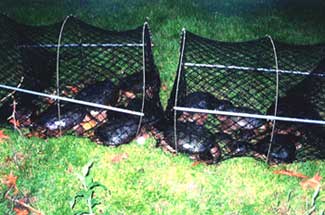
One of the problems facing anyone who wants/needs to trap turtles is the shear size of most of the traps on the market today. Many of them are rigid, and the size of small refrigerators, not to mention that they may cost as much as a couple of hundred dollars or more. The question quickly becomes.... "how many of these can you fit in your service vehicle", and once you're done with them..."where will you store them" ?


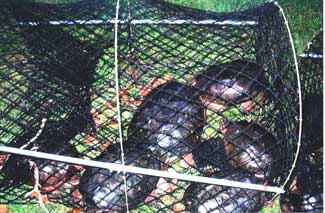
The Turtle Trap by WCS addresses both of these items. This fully collapsible turtle trap is made exclusively for WCS and is designed to handle the largest of turtles. The trap when set up measures 30"W x 25"H x 47"L. It has 3 D-Shaped hoops made of spring steel which forms the trap body, this trap won't roll when placed in the water. The net mesh is 2.5" square and is very durable and will give years of service.


The trap comes complete with "spreader" rods to hold the trap in its' rigid set position. It also has a bait bag included in the rear of the trap for ease of setting. PLEASE NOTE: Leave the top 1/4 of the trap exposed above the surface of the water. Turtles need to be able to come up for air, if you completely submerge your turtle trap you will kill the turtles. If you want to catch turtles and don't want to deal with a cage as large as a refrigerator, this trap is the ticket !

BAITING: This trap is very easy to bait. You take the removeable bait bag (included) out of the trap and fill it with small sun fish, suckers, chicken necks, a piece of beef liver, any type of bloody meat. Then tie the bait bag back into the interior center of the trap. The turtles will smell the bait and enter the trap through the large funnel opening, but can't find their way out. When using a large number of turtle traps it is handy to fill all your bait bags ahead of time and then place them in the freezer. When it is time to go catch turtles, simply remove your pre-loaded bait bags from the freezer and you are ready to go turtle trapping.

WCS Turtle Trap

WCS Collapsible Turtle Traps


Monday, July 02, 2007

Groundhog Kokaine

Let me dispel any myths about what it is………..and what it is NOT !

The BASE of "Ghog Kokaine" is in fact horse sweet feed. But it is just that the BASE, not the active ingredient or major attraction. The horse sweet feed is sprayed with a formulation which is provided to us from James White, the inventor. WCS makes the Ghog Kokaine according to the exact directions provided to us by the inventor and we package it in gallons. It is made FRESH as orders are submitted, WCS does not make Ghog Koke and store it, it is a FRESH bait.

Now, all that being said, will horse sweet feed catch ghogs......."probably", but not nearly as effectively or as lasting as the sprayed material. That’s like saying will straight fruit paste catch a squirrel, sure....but not nearly as many or as consistently as when nut oils are mixed with it !! 'nough said !!

Thursday, June 21, 2007

WCT Conference 2008

Just received word from Lisa Erickson, for those of you that haven't heard yet, the 2008 WCT/NWCOA Conference
will be held at the Radisson Hotel in Covington, Kentucky on January 28, 29, & 30.  I believe this will be our 10th
WCT Conference, wouldn't miss it, see you all there !   As more information becomes available I will be sure to post it. 


Thursday, June 14, 2007

Starling Stopper


FROM: Wildlife Control Supplies, LLC


FOR IMMEDIATE RELEASE - NEW PRODUCT


The Starling Stopper is a bird trap designed to humanely and safely remove
baby starlings, at least 1 ½ weeks old, from bathroom and dryer exhaust
vents. The trap itself is 3 ¼ inches in diameter, 9 inches in length and
weighs less than a half pound. It has a clear plastic one-way door to allow
baby birds to enter the trap, and a removable nose cone to allow easy
removal of birds once caught in the trap.

To operate, simply remove the exterior vent cover from the dryer vent in
which the birds are nesting. The mother will typically fly out within 3 - 5
minutes. After insuring the mother bird is out, insert the Starling Stopper
into the vent pipe as far as possible. Seal any gaps between the trap and
the vent pipe with duct tape. Remove your ladder. The mother bird will
return and perch on the edge of the Starling Stopper. She will call her
young into the trap and feed them through the screen on the nose cone.
After 24-36 hours, remove the young from the trap (usually 1-3 at a time)
and place them in a transfer cage to be taken to a rehabilitator, relocate
them nearby or euthanize them, following all applicable local laws.
Re-insert the trap into the vent pipe and repeat until there are no longer
sounds coming from the dryer vent.

Typically starlings will have 2-3 broods per year with 4-6 young in each
brood between March and July. Starlings may carry bird mites and
histoplasmosis spores. Always wear protective gear such as rubber gloves
and a HEPA filter mask when working with or near birds or bird droppings.

Wednesday, June 13, 2007

A All Animal Control

A All Animal Control Opens 15th Franchise Location Scott Buzby from Edina,
Minn., has acquired the rights to A All Animal Control's Minneapolis/St.
Paul franchise (6/12/2007)
MINNEAPOLIS - Scott Buzby from Edina, Minn., has acquired the rights to A
All Animal Control's <http://www.AAllAnimalControl.com> Minneapolis/St.
Paul franchise and is preparing for its grand opening.
"Scott brings a deep knowledge of wildlife management to his operation and
we are excited to have him as the newest member of our team," said Mark E.
Dotson, chief executive officer of A All Animal Control.
The Minneapolis/St. Paul location marks the 15 franchise office for A All
Animal Control. Starting from its original location in Colorado, A All
Animal Control has grown into a National Wildlife Management company with
offices coast to coast.

Daytime Prowlers, Nightime Howlers Roam Neighborhoods

From June 9, 2007 Danbury News Times, by Robert Miller

In Danbury, Connecticut, Jean Pawlik saw a coyote on her lawn on as well as a night of wild howling and yipping.
Her neighbors have seen coyotes within 15 feet of their houses and others in the area are hearing the same late-night symphony and seeing coyotes out and about in daylight.
Dale May, director of the Department of Environmental Protection's wildlife division, said Friday that male and female coyotes are now busy providing for their offspring. Coyotes don't have packs, but they do maintain a family unit from spring to fall. They mate in early spring and their pups are born in mid-April or May. While the parents are not strictly monogamous, they can stay together for several years, rearing the pups together. The social group breaks up in the fall, when the pups go off to live on their own.
While people have seen coyotes confront family dogs, May said that's probably more of a territorial face-off than looking for a meal. In general, coyotes are wary of humans.
"Unless a coyote is sick, injured, or aggressive to humans, we don't do anything,'' said Officer Craig Simone of the city's Animal Control Division.

Sunday, March 18, 2007

AnimalRemovalPro.com

WCS is pleased to introduce for its' professional customers a NEW web-based referral service called AnimalRemovalPro.com. AnimalRemovalPro.com is a professionally designed website with its' sole purpose being to drive service seeking customers to our WCS customers.

Clients needing nuisance wildlife control services can go to AnimalRemovalPro.com, plug in their zip code and they will be presented with wildlife control companies operating within a particular mileage range.

There is no additional charge to WCS business customers for this service. To our knowledge there is no other wildlife control or animal handling distributor offering this service. Just another way that WCS says "thank you" !

Wednesday, February 14, 2007

Speed Dip as a Protective Trap Coating

Throughout the course of a year WCS fields many questions regarding the products, the need and the method (s) used for protecting traps from harmful rust. Rather than trying to be all things to all people, if you know what I mean, I'm going to limit this post to the use of the protective dip product which is mixed with gasoline, sometimes commonly referred to as Speed Dip. While there are a number of trap dips on the market that utilize gasoline for dilution, Speed Dip is the trade name developed by Andy Stoe of Penn Yan, NY. and has been in widespread use by trappers for 25+/- years.

Speed Dip is a petroleum-based product and is available in black, brown, or white colors. It is packaged in paint can containers and is marketed in quart and gallon sizes. Speed Dip should be diluted 3 to 1, meaning for every unit of Speed Dip you would ADD 3 units of white gasoline. For example for every quart of Speed Dip product, you would ADD 3 quarts of white gasoline, making a total of 4 quarts of mixture. PLEASE NOTE: There are two important points to remember when working with any gasoline products...this should be used out of doors, in the open air, NOT IN THE GARAGE. Also, SPEED DIP is highly flammable once mixed and needs to be mixed and stored in a proper container.

I like to store the Speed Dip mixture in a 5 gallon bucket, new buckets and lids can be purchased at you favorite big box home improvement store. Once mixed, according to the ratio mentioned above, you can dip your traps as needed and seal the bucket with a tight fitting lid to avoid evaporation. Over time, if the mixture becomes weak, or is not coating your traps as well as you'd like, simply add alittle Speed Dip concentrate to your already prepared mixture.

Let me stop right here and point out a problem area we've seen trappers or wildlife operators get themselves in to ! We ALWAYS, ALWAYS recommend using the highly refined white gas (otherwise known as Coleman fuel) to mix with the SPEED DIP concentrate as it results in a nice dry, shiny, non-stick protective coating on your traps. Some folks decide to go down their own path and take the "cheap" route and buy the least expensive unleaded fuel they can find. Then they wonder WHY their traps remain sticky & gummy, making their hands black every time they touch them. Heed my warning....'nough said !!

Now, working out of doors, you've mixed up your speed dip 3 to 1 as we recommend into a 5 gallon container or the like and you're ready to dip your traps. STOP...before you get started their are a few things you should consider. Clothing for one, the speed dip will coat your clothing just as well as your traps, and I don't care how careful you think you're going to be, wear clothing & shoes that you want mind becoming stained. Gloves, not the thin latex gloves, some thicker rubber gloves to protect your hands. Eye protection, you don't want to splash any mix and get some in your eyes. Now you're ready...........

For foothold and bodygrip traps you simply immerse them into your bucket and if there are spots that don't quite fit into the solution use a disposable paint brush to cover the exposed area. For cage traps, you can use a shallow pan, something like an oversized cookie sheet, it only needs to be approx. 1" deep. Pour your solution into the pan, then place a cage in the shallow pan and roll it so all four sides are coated, including the back and the front door. The paint brush really comes in handy for cages. Hang your dipped traps outside on a rack or in a bush or tree for 1 - 3 days, depending on temperature and air circulation your traps will be dry and ready to go. It is important to note that traps can be dipped right out of the box, there is no need to rust or even degrease them prior to dipping.

Dip solution can be stored for an indefinite period in a proper container. When traps become rusty or the protective coating is worn off from use, simply re-dip.

Sunday, February 11, 2007

Kaba Bird Shock tape for Billboards


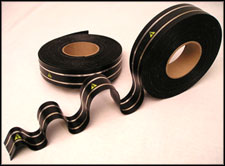
KABA bird shock tape is ideal for billboard structures because the 1/32" flat profile doesn't represent a significant trip hazard to workers. KABA is the most flexible electrical product ever offered because it is 'tape'. Changing elevations or hopping over the bolts heads is done without having to end runs and make electrical connections. It can be rolled out on horizontal or vertical surfaces. It can be laid upon small diameter pipes and catwalk toe plates. Of the many billboards where KABA has been installed, board owners elected to have a dedicated A/C circuit tied to a circuit breaker found at the base of the mast pole to disable the system while workers perform routine maintenance tasks. The pictures taken are of the KABA rubber tape product, which is black in color. Its glued on with a urethane sealant adhesive, commonly found at any home improvement store. Please note:
KABA is also available as a peel & stick "clear" product for architecturally sensitive or historically significant structures where invisibility of the product is of the utmost importance. The kaba tape is actually clear although the picture shows it with a red backing which is peeled off when applied. The clear kaba tape has its' own adhesive.

Saturday, September 16, 2006

WCS Multi-Catch Rodent Trap


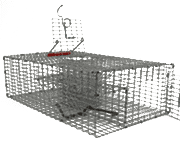
WCS has just introduced their NEW Multi-Catch Rodent trap to the wildlife/pest control markets. There isn't any other trap on the market which provides multi-catch capabilities for chipmunks, rats, and flying squirrels. The WCS Multi-Catch Rodent trap measures 20"L x 12"W x 6"H, and is constructed of 1" x .5" rust resistant, galvanized wire mesh which will render years of service.

The trap features two (2) counter-balanced entry doors, one on each end of the trap which can easily be adjusted for sensitivity by adding or deleting weight on the triggering rods. There is a centrally located bait chamber in the center of the trap, which is equipped with a removable bait basket for ease of baiting or cleaning. There is a latch secured door over the top of the bait chamber and on one end of the trap for easy removal of captured animals.

Animals enter the trap in an attempt to access the bait in the center of the trap, their body weight depresses the inclined door which entices them to enter the interior of the trap (like a see-saw). Once the rodent steps off the opened door the counter-balancing weights close the door behind them. It's that simple !

For baiting you simply remove the bait basket, fill with your favorite rodent bait, i.e. sunflower seed, oatmeal drizzled with pancake syrup, bird seed, bacon grease, etc. Secure the bait in the interior bait chamber and the trap is ready to be placed into position. For chipmunks that may be along a foundation, a stone wall, underneath a bird feeder , etc. For rats, since they are neophobic, you need to be patient, however along a wall or right in the rats pathway. It will take several days for the rats to acclimate to the trap. Flying squirrels are commonly identified as a nuisance in attic spaces, the trap is perfectly sized to be placed there, or in crawlspaces, etc.
I would recommend placing apple slices in the interior of the trap (outside of the bait chamber) if it will be checked on an extended basis.

Saturday, June 10, 2006

Snakeguard Snake Traps

There are basically two commercially available snake traps on the market today. They both operate on the same principle, that is to place the snake trap in such a manner as to force the snake to enter the snake trap, whereby it is captured on a glue strip or glueboard. A snake when encountering the glue surface inside the confines of a trap cannot merely turn its' head and leave the trap without being captured. A snake must draw its' entire body into the trap, in an attempt to reverse direction and thereby is captured in the glue along its' entire bodylength.

The formulation of glue used in both of the snake traps is such that it can be neutralized if the desire is to capture a snake and then relocate it. Neutralization of the glue is accomplished by pouring regular vegetable oil (or spraying a vegetable oil such as PAM) on the captured snake along its' entire length. It typically will take from between a half and a full cup of vegetable oil to release a snake unharmed. This process will take several minutes, so you need to be patient.

The Snakeguard Snake Trap which was the first to hit the commercial market has enjoyed widespread acceptance among professional operators and homeowners for capturing and removing snakes. This snake trap, constructed of corrugated cardboard has a glue "pattern" built into the inside of the trap. The glue pattern is in the shape of a "V", where the point of the "V" touches the extreme outside edge of the snake trap on its' inside. This requires that the snake fully enter the snake trap before its' head initially encounters the glue. When the snake attempts to leave by drawing its' body in behind itself its' body is "stuck" to the outwardly positioned legs of the "V" glue pattern. The Snakeguard snake trap is an excellent tool for indoor applications such as a sunroom, porch, garage, basement area, etc. Due to its' construction material it is not so well suited for outdoor areas.
snakeguard snake trap
Setting the Snakeguard Snake Trap: The Snakeguard snake traps initially come completely flat for ease of shipping. Remove the outer plastic covering that it comes shipped in and open the snake trap at its' midpoint to expose the "V" pattern of glue which has two protective strips covering it. While holding the box open, firmly grasp one end of one of the protective strips and peel off, exposing the underlying glue. Do the same for the remaining side. While continuing to hold the box open, bend the corrugated cardboard along the pre-defined lines, such that it forms a rectangular box. There are two tabs located on one side of the outside edge of the rectangle. These are placed through their corresponding slots in the roof of the snake trap so the box holds its' shape. You should now have a rectangular box with the Snakeguard logo on top, with the glue exposed on the inside. The only thing left to do is to place the snake trap along a wall, foundation or similar which will guide the snake into the trap. It sometimes helps to place a piece of duct-tape from the inside edge of the snake trap to the wall it is placed against so the snake cannot attempt to "squeeze" between the box and the wall without entering the trap.

The Snakeguard snake trap is able to capture some of the largest nuisance snakes as we have personally seen it capture black snakes in the 5.5 ft. range. These traps are available at
www.wildlifecontrolsupplies.com

Friday, May 05, 2006

Bat Cone improves bat exclusions


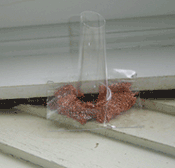
The BATCONE is a new time-saving bat exclusion device, invented by Jim Dreisacher who owns and operates Westchester Wildlife. The BAT CONE basically is a humane, one-way door for bats to leave the structure and NOT return.

The BATCONE is currently produced in two models; 1. the Standard Bat Cone, which is one-piece and is made of lightweight, yet durable plastic. As the name implies it is a cone or tapered funnel 5.75 inches long, with a 1.5 inch opening at the end. At the opposite end, or the end you would attach to the structure there is a rigid plastic flange which is 6 inches by 6 inches. As with both of the Bat Cone models the flange can be cut or bent to the angle of the structure for anchoring. The bat cone can be anchored using deck screws (wood) , stapled or even taped over a bats entry/exit point. The optimal position of the BAT CONE once it is installed is for it to have a slight downward slope. Bats cannot grip the inside of the bat cone, once they exit through the cone, they cannot re-enter.

As you can see in the photo, it is sometimes necessary to add some copper mesh underneath the BAT CONE to take up the space between the bat cone and the structure. The only opening you want for the bats to exit is through the BATCONE. To limit the exit point for the bats you may also need to apply a closed cell foam such as Todal foam, or caulk on each side of the opening.

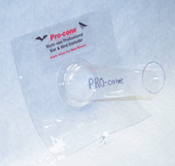
2. Pro-Cone is the latest bat cone model that has been developed. The ProCone is a two-piece bat cone, with the flexible vinyl flange being separate from the tapered plastic cone. The ProCone measures approximately 6" in length with a 1.5" opening on one end. The vinyl flange measures 7 inches by 7 inches, making it versatile for mounting to structures, including dissimilar surfaces, i.e. stone chimney up against clapboard siding. While both models of bat cone are reusable , the ProCone lends itself especially well being to being reusable as the vinyl flange material can be purchased separately.

Pro-Cone can be screwed, stapled or taped into position over a bats entry/exit point. With the optimal positioning being a slight downward slope to the tapered cone.

Once a BATCONE is mounted over a bats entry/exit point in a structure it should be left in place a reasonable amount of time to allow the bats to exit the structure. This time period will vary, however 5 - 7 days is typically sufficient according to Bat Conservation International. Leaving a bat cone in place for longer periods is not detrimental. Please Note: It may be necessary to use more than one Bat Cone to exclude bats from a structure. All entry/exit points on a structure must be identified and a bat cone installed to successfully exclude the bats. Failure to follow this procedure may result in merely moving the bats to another part of the building.

Once it has been determined that the bats have been successfully excluded from a structure it is then necessary to remove each of the installed bat cones and permanently seal the exit point openings using hardware cloth or copper mesh inseted into the hole and then completely sealed with closed cell foam or a quality silicone caulking.

The BATCONE or Pro-Cone are both time-saving devices for excluding bats from structures and eliminate the need to fabricate something onsite. The bat cone looks professional when mounted and will leave your customer with an impression of confidence in your ability to solve their bat problem.