Thursday, March 26, 2009
STATE LEGISLATORS DON’T GIVE A DAM ABOUT THE CT RIVER VALLEY
Ban on Trapping Threatens Integrity of Connecticut River Flood Protection Dikes
West Hartford, CT. (March 26, 2009) – State Legislators may soon be voting on a controversial measure to ban certain kinds of traps in Connecticut, including traps currently used by wildlife professionals to control burrowing animals in the Connecticut River levee system. The Connecticut Nuisance Wildlife Control Operators Association, Inc. (CTNWCO Assoc., Inc.) expressed alarm at this proposal, citing millions of dollars in repairs to the levee system attributed to wildlife problems over the past several years. The same Legislators considering this ban have already allocated millions of taxpayer dollars to protect the safety and property of residents in the areas of these levees. "We are deeply concerned about the state's ability to continue to keep the population levels of these animals in check without these vital tools," said Tom Logan, Vice President and spokesman for the CTNWCO Association. The General Assembly's Environment Committee recently approved a bill co-sponsored by Hartford state Senator John Fonfara and Plainville Representative Elizabeth "Betty" Boukus to ban foothold and Conibear traps in the state.
According to Nick Casparino, a Civil Engineer for the town of East Hartford, the town last year alone paid a private contractor $4 million to repair nearly four miles of town-owned dikes that protect it from the Connecticut River. The town has allocated $25 million to rehabilitating the dike system. Casparino said that more than $58,000 has been paid to the contractor so far for controlling and repairing wildlife damage to the dike system, but the project is still ongoing. Mr. Casparino said that the US Army Corps of Engineers is requiring an ongoing program to control wildlife and remediate the damage caused by wildlife, which is very extensive since they must bring in heavy equipment every time an animal burrows into the earthen dike.
According to a 2005 report on the state's dams, "Dam Safety in Connecticut", compiled by the Connecticut Department of Environmental Protection's Bureau of Water Management, Connecticut had 22 deficient dams in 2004. The US Army Corps of Engineers' 2007 report on National Inventory of Dams indicated that there are 468 earthen dams in Connecticut, representing 64% of the 723 dams in the state. This report also indicated that 62% of the dams are privately owned, and 18% are owned by local governments. Wesley Marsh of the bureau of Water Management stated, "It will be hard to tell a private levee owner that they need to remedy a wildlife issue, then have the wildlife department tell them that they cannot trap the animal. Especially if they had a trapper previously managing the beaver population for no charge."
According to USA Today's December 22, 2008 article, "Most Levee Repairs Lagging", the US Army Corps of Engineers indicated that the worst offenders are Washington and California, where levees with "unacceptable maintenance deficiencies" protect densely populated cities like Seattle and Sacramento. While Connecticut has recently provided $5 million to improve Hartford's levees, no one knows how this trapping ban will affect the cost of repairing the levees in the future. One has to wonder if it will even be feasible to perform the repairs without being able to use the proper tools, such as traps, to control the burrowing animals causing the damage. If the repairs are delayed, the US Army Corps of Engineers could bar access to recovery funds, should there be a catastrophe. Tom Logan, Vice President of the Connecticut Nuisance Wildlife Control Operators Association, Inc., states, "The state lawmakers need to look at the overall picture of this ban on trapping, and look at where these tools can be used effectively to manage wildlife to protect human interests. How will a muskrat or beaver that is burrowing into a levee be caught without these tools being available anymore? It's ironic that the two states that are the worst offenders are states that ban these traps."
According to Dan Marks, a civil engineer and a consultant of the Association of State Dam Safety Officials, burrowing animals like muskrats and beavers are the two most common wildlife species to cause structural damage. Muskrats burrow into the levees and weaken their integrity. Beavers obstruct spillways, burrow into the levee, and move mud and material to create their own dams. Mr. Marks says that water level devices are not a good option since they are expensive to install and maintain. He stated that last year in June a muskrat had undermined a repaired water-saturated levee that was holding back the relentless Mississippi River in eastern Missouri. The town residents had worked for several days to maintain the levee from the rising waters. This only affected about 100 homes, but the levee was protecting an area of about 3,000 acres, and the damage happened when everyone was sleeping.
Muskrats and beaver aren't the only wildlife causing damage to dikes.
"How can we control moles that are eroding the surface of these levees?" asked Richard Daniotti, owner of Wildlife Control Services of West Hartford. "These lawmakers are supposed to look out for the environment and the people. Yet if they ban the use of traps, they will only cause more poisons to be absorbed into the environment, including our waterways." Daniotti also pointed to the FEMA (Federal Emergency Management Agency) technical manual for wildlife control professionals to use in managing these animals, "FEMA highly recommends these same traps that the state lawmakers are trying to ban."
The Connecticut Department of Environmental Protection's Deputy Commissioner, Susan Frechette, testified at the environmental lawmakers hearing on March 9th in opposition to the trap ban, citing a detrimental impact on wildlife management. She testified that if the traps are banned under the proposed legislation, the most effective, and for some species, the only effective tool, will no longer be available to wildlife control professionals. Senator Edward Meyer of Guilford responded to Deputy Commissioner during the hearing by saying, "I am appalled that the department is condoning the use of these traps"
The Connecticut Nuisance Wildlife Control Operators Association is a non-profit organization to promote general standards and ethics as well as foster education, research, and knowledge within the nuisance wildlife control industry.
###
For more information on this topic or to schedule an interview with Tom Logan, please call 203-375-1211 or email Wildthingsllc@att.net
or
Richard Daniotti at 860-236-2683
Or visit our website www.ctnwcoa.com
--
Alan A. Huot, President
Wildlife Control Supplies
P.O. Box 538
East Granby, CT 06026
860-844-0101 860-413-9831 (FAX)
www.wildlifecontrolsupplies.com
"Products for Professionals"


Monday, November 24, 2008
Nomol Trap Setting
See a brief video clip of "How to Set the NoMol Trap" from the complete production
MOLES: Removal made Simple. Just posted on YouTube:
http://uk.youtube.com/watch?v=MZE6qoEA73A
Thursday, October 30, 2008
Thursday, October 16, 2008
The Collarum
Short video clip of the Collarum "In Action" at the National Wildlife Research Center in Denver
Wednesday, October 08, 2008
Camporee 2008
Wow, Fantastic, Tremendous........a helluva lot of fun, those are just some of the words I'll use to describe the recent 1st Annual Camporee coordinted by none other than Kirk Lapierre. As with anything Kirk puts his mind to he pours his heart and soul into his endeavors and it sure came through at this event. The weather helped of course as it was an absolutely perfect early October day, but the food was out of this world, basically eat 'til you drop, there were scheduled demonstrations going on throughout the day, and of course the swap meet or tag sale tables. You could tell that people really enjoyed the day. 
Unfortunately, I didn't get to attend the entire event as I had other commitments for the early part of the weekend, but Sunday was everything I described above. I picked up Jim Dreisacker (BatCone) on the way down and the State campground was very easy to find, it is almost parallel to the Hudson River. The grounds are wonderfully kept, it had a nice outdoor pavilion and I'm told the lodge where folks could sleep was very nice as well.
I for one am hoping Kirk has enough energy to pull the Camporee together for next year, this is certainly an event well worth supporting and for those that decided not to attend they really missed a worthwhile event. Kirk, please sign me up for next year !!

Unfortunately, I didn't get to attend the entire event as I had other commitments for the early part of the weekend, but Sunday was everything I described above. I picked up Jim Dreisacker (BatCone) on the way down and the State campground was very easy to find, it is almost parallel to the Hudson River. The grounds are wonderfully kept, it had a nice outdoor pavilion and I'm told the lodge where folks could sleep was very nice as well.
I for one am hoping Kirk has enough energy to pull the Camporee together for next year, this is certainly an event well worth supporting and for those that decided not to attend they really missed a worthwhile event. Kirk, please sign me up for next year !!

Monday, September 22, 2008
Critter Control Opens CT office

WCS had the pleasure of a visit by one of Critter Control's newest managers, Ray "Doug" Humphrey. Ray is the new manager of the Central Connecticut area office.
He comes to Critter Control with 28 years experience in a suburban police dept., and Doug has dealt with and resolved many conflicts between wildlife and people. WCS recently received an announcement from Critter Control's CEO, Kevin Clark, notifying the wildlife industry of their new office and introducing Doug. Doug brings with him a variety of skills, including his extensive investigative knowledge which will serve him well as a Critter Control representative.
WCS welcomes Doug Humphrey to the wildlife control industry !
Friday, September 05, 2008
NPMA 1st Nuisance Bird & Wildlife Conference - Nov. '08
The National Pest Management Association's First Ever Nuisance Bird and Wildlife Management Conference & Marketplace!
Educational Program & Registration is Live!
The National Pest Management Association (NPMA) is excited to offer its first ever Nuisance Bird and Wildlife Management Conference and Marketplace, November 19-21, 2008 at the Westin St. Louis in St. Louis, Missouri. The schedule of events and educational program including speakers is now online.
Click here to register.
Click here to view the conference program.
What It's All About?
This first rate educational program is divided into two tracks – an introductory track aimed at newcomers to nuisance bird and wildlife management and an advanced track geared toward veterans of this sector. From regulatory requirements, business models and public perception to mole control, bat management and bird control – both tracks provide valuable business and technical information for your level of service.
Who Should Attend?
Anyone who currently provides pest and nuisance wildlife management services, is just entering the market, or considering expanding their service offerings to this sector – this conference is for you!
Click here to register.
Take Advantage of the Marketplace!
A centerpiece of the conference is the Marketplace, which will connect pest and wildlife management professionals from around the country with suppliers of products and services related to this sector. During the conference, attendees will explore new business opportunities in the nuisance wildlife arena for the pest management professional.
Interested in Exhibiting at the Marketplace?
Space is filling up fast! Click here for more information or contact Alexis Wirtz at awirtz@pestworld.org or call 703-352-6762.
Thank You to Our Co-Sponsors!
Critter Control
National Wildlife Control Operators Association (NWCOA)
Wildlife Control Supplies
Educational Program & Registration is Live!
The National Pest Management Association (NPMA) is excited to offer its first ever Nuisance Bird and Wildlife Management Conference and Marketplace, November 19-21, 2008 at the Westin St. Louis in St. Louis, Missouri. The schedule of events and educational program including speakers is now online.
Click here to register.
Click here to view the conference program.
What It's All About?
This first rate educational program is divided into two tracks – an introductory track aimed at newcomers to nuisance bird and wildlife management and an advanced track geared toward veterans of this sector. From regulatory requirements, business models and public perception to mole control, bat management and bird control – both tracks provide valuable business and technical information for your level of service.
Who Should Attend?
Anyone who currently provides pest and nuisance wildlife management services, is just entering the market, or considering expanding their service offerings to this sector – this conference is for you!
Click here to register.
Take Advantage of the Marketplace!
A centerpiece of the conference is the Marketplace, which will connect pest and wildlife management professionals from around the country with suppliers of products and services related to this sector. During the conference, attendees will explore new business opportunities in the nuisance wildlife arena for the pest management professional.
Interested in Exhibiting at the Marketplace?
Space is filling up fast! Click here for more information or contact Alexis Wirtz at awirtz@pestworld.org or call 703-352-6762.
Thank You to Our Co-Sponsors!
Critter Control
National Wildlife Control Operators Association (NWCOA)
Wildlife Control Supplies
Wednesday, December 26, 2007
WCS joins YouTube

WCS has uploaded the first of many instructional videos to come to YouTube. YouTube with its' huge presence in cyberspace is an excellent medium for communicating short instructions on such things as using equipment, methods, techniques, new products, etc.
There are certain products which people find particularly confusing and those will be our initial focus. The first instructional video covers the proper and safe setting of the Belisle Footsnare. We have found the manufacturer supplied printed directions less than adequate for explaining the setting of this device.......so this is our "trial balloon" if you will. If there is a particular device or technique you'd like to see us include, please feel free to send us a note, we'll place it on our list.
So let me invite you to our Channel on YouTube, feel free to subscribe and be notified when new videos are uploaded. Click below:
www.youtube.com/shopwcs
There are certain products which people find particularly confusing and those will be our initial focus. The first instructional video covers the proper and safe setting of the Belisle Footsnare. We have found the manufacturer supplied printed directions less than adequate for explaining the setting of this device.......so this is our "trial balloon" if you will. If there is a particular device or technique you'd like to see us include, please feel free to send us a note, we'll place it on our list.
So let me invite you to our Channel on YouTube, feel free to subscribe and be notified when new videos are uploaded. Click below:
www.youtube.com/shopwcs
Wednesday, November 07, 2007
Weep Holes for Rodent Prevention

As we enter the fall season many pests will gain access to commercial and residential accounts via weep holes in the buildings of these accounts. Weep holes are either the gaps left between some bricks in external walls or the small openings in window framing. Weep holes serve two important purposes: 1) Ventilation of the internal wall cavity - without ventilation, mildew, dry rot and damp reduce the life of the internal wall studs and other building materials within the cavity, and 2) Drainage - water that enters the cavity due to capillary action, condensation, damage, or accidental flooding needs to escape somewhere.
Though necessary, unfortunately, weep holes also present a problem in that they also provide access to the wall cavity for rodents and insects, especially as temperatures cool down and pests seek harborage for warmth. Swarming bees and European wasps also love cavities. Field mice make a track through the weep holes looking for nest sites. Snakes, cockroaches and spiders find refuge in the cavity.
In desperation, many homeowners and commercial building occupants will resort to blocking weep holes with any number of materials such as silicon sealants, rolled up paper, plastic, scourer pads or steel wool to keep the pests out. These so-called solutions obstruct airflow to the cavity and set up moisture problems down the road. This can be very costly to fix later. The better way is to use small mesh screening inserts or weep hole inserts that can be purchased from your distributors or construction product distributors. These will keep the pests from entering in the first place. Applying a repellent residual first can also be useful for insect pests.
When thinking about pests that enter the weep holes, keep this rule of thumb in mind.1/2, ¼ and 1/16. Rats require a space only ½ of an inch wide to enter a building. Mice require a space of only ¼ of an inch wide to enter a building. And, most insect pests require only 1/16 of an inch wide space to enter a building. Weep holes come in various sizes, but can allow for most any of these pests. Excluding them with inserts or screening that allows the weep hole to still function as it should, while preventing the pests from entering is what is needed to properly keep pests out.
Though necessary, unfortunately, weep holes also present a problem in that they also provide access to the wall cavity for rodents and insects, especially as temperatures cool down and pests seek harborage for warmth. Swarming bees and European wasps also love cavities. Field mice make a track through the weep holes looking for nest sites. Snakes, cockroaches and spiders find refuge in the cavity.
In desperation, many homeowners and commercial building occupants will resort to blocking weep holes with any number of materials such as silicon sealants, rolled up paper, plastic, scourer pads or steel wool to keep the pests out. These so-called solutions obstruct airflow to the cavity and set up moisture problems down the road. This can be very costly to fix later. The better way is to use small mesh screening inserts or weep hole inserts that can be purchased from your distributors or construction product distributors. These will keep the pests from entering in the first place. Applying a repellent residual first can also be useful for insect pests.
When thinking about pests that enter the weep holes, keep this rule of thumb in mind.1/2, ¼ and 1/16. Rats require a space only ½ of an inch wide to enter a building. Mice require a space of only ¼ of an inch wide to enter a building. And, most insect pests require only 1/16 of an inch wide space to enter a building. Weep holes come in various sizes, but can allow for most any of these pests. Excluding them with inserts or screening that allows the weep hole to still function as it should, while preventing the pests from entering is what is needed to properly keep pests out.
Monday, October 15, 2007
PestWorld 2007
PestWorld 2007 is the last major show of 2007 that WCS attends. This year the National Pest Management Association (NPMA) has chosen the Gaylord Palms hotel in Orlando, FL for the site of PestWorld, and is being held from Oct. 16 through the 20th.
This is a major event in the wildlife/pest control industries and I highly recommend attending to anyone just "thinking about it" ! Out side of the tradeshow area which contains all of the major manufacturers and distributors in the industry there is a wealth of information and educational opportunities going on in the sessions being held throughtout the show. The NPMA does an excellent job of attracting and presenting an information filled program that everyone will find something of interest. This is a top-notch quality event.
For those of you attending the show, please be sure and stop by booth #818 and visit with us.
See you there.....
Alan
This is a major event in the wildlife/pest control industries and I highly recommend attending to anyone just "thinking about it" ! Out side of the tradeshow area which contains all of the major manufacturers and distributors in the industry there is a wealth of information and educational opportunities going on in the sessions being held throughtout the show. The NPMA does an excellent job of attracting and presenting an information filled program that everyone will find something of interest. This is a top-notch quality event.
For those of you attending the show, please be sure and stop by booth #818 and visit with us.
See you there.....
Alan
Tuesday, September 18, 2007
Pneu-Dart Distribution

Wildlife Control Supplies is proud to announce the addition of Pneu-Dart’s chemical capture remote injection delivery systems to their customer product offering. Recognizing the need for its’ professional customer base, WCS selected Pneu-Dart for its’ quality, excellent product support, and wide range of products. Pneu-Dart, of Williamsport, PA, has been manufacturing quality equipment for remote drug delivery since 1967. Pneu-Dart offers a wide range of air-activated, cartridge-fired and gas-powered projectors. From the popular Blo-Jector blowgun style projector to the new high-tech X-Caliber gauged CO2 rifle, Pneu-Dart has the drug delivery solution to suit every professionals needs.
Pneu-Dart also manufactures a vast line of dart types. A variety of injection darts are available, as well as darts for collecting DNA and biopsies. There are also transmitter darts, marking darts and the ever-popular Bear-Scare dart, designed to blow apart on impact and frighten off aggressive animals without harming them.
Wildlife Control Supplies is pleased to offer our customers this exciting line of products. Contact us toll-free 1-877-684-7262 or on the web at http://www.wildlifecontrolsupplies.com/.
Pneu-Dart also manufactures a vast line of dart types. A variety of injection darts are available, as well as darts for collecting DNA and biopsies. There are also transmitter darts, marking darts and the ever-popular Bear-Scare dart, designed to blow apart on impact and frighten off aggressive animals without harming them.
Wildlife Control Supplies is pleased to offer our customers this exciting line of products. Contact us toll-free 1-877-684-7262 or on the web at http://www.wildlifecontrolsupplies.com/.
Sunday, August 26, 2007
NY State Trappers Convention
WCS will be attending the NY State Trappers Convention being held in Herkimer, NY over the Labor Day weekend. This is perhaps the eighth or ninth year in a row that we've attended this show. It has gotten to be a mixture of business and pleasure for us as it is as much a social event as anything else. This show draws an excllent crowd and there always is a large number of familar faces. If you haven't ventured out to a show like this in the past I would highly recommend it. The area is great for sightseeing also !
Anyway, I wanted to post something regarding this show since we are setting up a booth in the main building, we will be pulling our trailer and bringing products for display. However, this year we will be traveling "light" as we will be picking up a large quantity of goods during and after the show. By necessity, we cannot come fully loaded with products. My point in mentioning this is that if there is something you specifically need or want from us, don't leave it to chance that we will be bringing it. Call ahead, we will ensure it makes it onto the trailer. I'm just trying to avoid any disappointment. Even in past years, try as we do to bring a wide selection there is always someone who comes by and says "oh, I thought you'd be bringing that" ! Don't take the chance if you really need it......CALL !
Anyway, I wanted to post something regarding this show since we are setting up a booth in the main building, we will be pulling our trailer and bringing products for display. However, this year we will be traveling "light" as we will be picking up a large quantity of goods during and after the show. By necessity, we cannot come fully loaded with products. My point in mentioning this is that if there is something you specifically need or want from us, don't leave it to chance that we will be bringing it. Call ahead, we will ensure it makes it onto the trailer. I'm just trying to avoid any disappointment. Even in past years, try as we do to bring a wide selection there is always someone who comes by and says "oh, I thought you'd be bringing that" ! Don't take the chance if you really need it......CALL !
Sunday, August 19, 2007
Tube Trap Modifications
Tube Trap Customer Wrote:
Hi Alan I dont think anything less than my sample would be strong enough to absorb the huge impact. If you could get tubing just as hard as the sample that I am mailing it could work. Feel free to use what I tell you any way you want. If you make a million send me a box of double spring Koro traps. Please find attached the picture you requested. Also the rubber is held in place with two nuts and bolts. The rubber should be about a 1/4 inch up the slot so when it fires it wont bottom out and bend the rod. I don't know where you could get this rubber. I have a roll of it that was used to make pads for railroad track plates. Yes I am retired but if you want I could send it to you. Its quite heavy.
I will put the sample in tomorrows mail.
Bill Lane
Tuesday, August 07, 2007
Suggested TUBE Trap improvement from a customer
I thought folks might like to see this, a suggestion in from a customer on the TUBE TRAP. Just a note here……you should NOT DRY FIRE TUBE TRAPS as you would perhaps a bodygrip or foothold trap.
********************************************************************************
Hi Alan: Recently you were good enough to replace some Tube Traps that were damaged due to Dry Firing.
Well thank you very much !
I felt a little guilty taking them but have now figured a way to try and pay you back.
Please find attached some pictures of what I think is the answer to the problem. The rubber pad is meant to absorb the shock of any Dry Firing.
Also I figured how to straighten the kill rod after it gets bent.
I put the tube trap on my work bench and put a long screw driver on the inside of the trap and on the rod. With a lump hammer I give it a couple of shots and the rod returns to its original straightness. Simple but it took me a long time to figure it out.
The screw driver has to go thru the trap in the kill rod slot
Thanks Again
Bill Lane
Monday, August 06, 2007
Beaver: Live Trapping Techniques DVD Testimonial
Heres a testimonial we recently received on our NEW DVD titled "Beaver: Live Trapping Techniques"
Guys,
Our IADCA Association just bought your DVD as a giveaway in the raffle at our next meeting on Aug. 11. Since I bought it for the association I thought I should preview it to make sure it is acceptable for the members to view… ha ha. I must say you guys have produced the absolute best instructional DVD that I have ever seen. The photography and information presented is very clear and concise. Anyone buying this DVD to learn the equipment and techniques should be able to go right out and do a good job at live beaver trapping. That is quite unlike it was 14 years ago when I bought a two Hancock traps and had to learn by the “seat of my pants” including how to set the traps safely.
You guys have set the standard for instructional information and one can only hope that others will take the cue from you.
Thank you, Tim Christie, Wildlife Management Services
Thursday, August 02, 2007
NTA Convention '07
I'm sitting in the Detroit airport on my way to the National Trappers Convention (NTA) being held Aug. 2 - 5 in Goshen, IN. I've attended these events since the early 70's, I think my first NTA Convention was at the Space Mink farm in Beemerville, NJ. Chuck Spearman was just introducing the Trapper Magazine (called the Midwest Trapper at the time), to the fur trapping community. There wasn't anything like it on the market at the time and Chuck timed the market perfectly as the fur market was experiencing a fur boom.
Anyway, back to '07, if you've never attended one of these events and you are interested in any aspect of capturing ot controlling wildlife I guarantee you it will be time well spent. While it remains primarily a fur-trapping focused event, there is no question that the wildlife control industry continues to increase its' presence. Hence, the reason for my going. There is equipment of all types, there are hobbyists, professionals, and weekend warriors , tailgaters selling used equipment, demonstrations ongoing and it is sure to be an action packed weekend.
While I have been attending these events for 30+ years I predict that this year will be a turning point in its' character. To set the stage for those that have never attended, the NTA Convention while being a week-long business meeting for the organization itself, it is also considered a modern version of the rendezvous' held by the mountain men of yesteryear. Now don't get me wrong, there is very little buckskin, few campfires, and no blackpowder shoots. What I mean is it has been "the" tradeshow of the fur industry where dealers of all sizes and sorts come together to market/sell their wares. Many dealers in the summer months are orphans from their families pulling oversized and many times over-weight trailers all over the country, packed with as large a quantity of inventory as will fit. The consumer (trapper) has used these conventions to purchase supplies for the upcoming season and avoid shipping costs.
While I still consider these events to be absolutely worthwhile and should/will continue for many years to come, what I predict is that the character of the Convention will EVOLVE into more of a mainstream show where dealers, manufacturers, factory reps. will set up displays and showcase their latest products, or hot products of the year, etc. But the hauling of a complete inventory of products all over the country will by necessity decline. Heres the nasty little secret....... the economics just don't support the rendezvous any longer. It's a known fact that everytime you move or touch a product it costs money. So by the time you load a product into a trailer, drive X number of miles, unload it, reload whatever doesn't sell after a convention, and then unpack it once you get back home .......... on top of $3.00 gallon +/- gas, food, hotel rooms, the expense of being away from the business. Do the math !
I'm not saying this change is bad, I'm just saying this is an evolution that makes sense. There are a number of very large and well known fur trapping supply dealers who will not be attending the '07 NTA Convention for the reasons I've outlined above. We'll see if my prediction comes true.
In the meantime, I'll be spending time with Tim Julien, Pres. of NWCOA, at the NWCOA booth.........it will still be fun !!! Just different !
Anyway, back to '07, if you've never attended one of these events and you are interested in any aspect of capturing ot controlling wildlife I guarantee you it will be time well spent. While it remains primarily a fur-trapping focused event, there is no question that the wildlife control industry continues to increase its' presence. Hence, the reason for my going. There is equipment of all types, there are hobbyists, professionals, and weekend warriors , tailgaters selling used equipment, demonstrations ongoing and it is sure to be an action packed weekend.
While I have been attending these events for 30+ years I predict that this year will be a turning point in its' character. To set the stage for those that have never attended, the NTA Convention while being a week-long business meeting for the organization itself, it is also considered a modern version of the rendezvous' held by the mountain men of yesteryear. Now don't get me wrong, there is very little buckskin, few campfires, and no blackpowder shoots. What I mean is it has been "the" tradeshow of the fur industry where dealers of all sizes and sorts come together to market/sell their wares. Many dealers in the summer months are orphans from their families pulling oversized and many times over-weight trailers all over the country, packed with as large a quantity of inventory as will fit. The consumer (trapper) has used these conventions to purchase supplies for the upcoming season and avoid shipping costs.
While I still consider these events to be absolutely worthwhile and should/will continue for many years to come, what I predict is that the character of the Convention will EVOLVE into more of a mainstream show where dealers, manufacturers, factory reps. will set up displays and showcase their latest products, or hot products of the year, etc. But the hauling of a complete inventory of products all over the country will by necessity decline. Heres the nasty little secret....... the economics just don't support the rendezvous any longer. It's a known fact that everytime you move or touch a product it costs money. So by the time you load a product into a trailer, drive X number of miles, unload it, reload whatever doesn't sell after a convention, and then unpack it once you get back home .......... on top of $3.00 gallon +/- gas, food, hotel rooms, the expense of being away from the business. Do the math !
I'm not saying this change is bad, I'm just saying this is an evolution that makes sense. There are a number of very large and well known fur trapping supply dealers who will not be attending the '07 NTA Convention for the reasons I've outlined above. We'll see if my prediction comes true.
In the meantime, I'll be spending time with Tim Julien, Pres. of NWCOA, at the NWCOA booth.........it will still be fun !!! Just different !
Friday, July 13, 2007
BEAVER: Live Trapping Techniques DVD
NEW PRODUCT
"BEAVER....Live Trapping Techniques" DVD
Wildlife Control Supplies, LLC is pleased to present the 2nd in a series of
educational wildlife control and animal handling productions this one titled
"Beaver ...Live Trapping Techniques".
This DVD features Don Lafountain, a Certified Wildlife Control Professional
(CWCP) and a nationally recognized beaver control expert. Don is also
co-owner of Integrated Wildlife Management, a company specializing in all
aspects of nuisance beaver control.
Don has 20+ years in the nuisance wildlife industry and conducts year-round
beaver control projects for State agencies, Fortune 500 companies as well
as private citizens in his home State of Massachusetts. This production
was filmed by two-time emmy award-winning videographer Eric J. Budney,
This DVD covers the following:
* Beaver Biology
* Proper Setting & Safely Handling the Hancock-style trap
* Trap Types Covered:
Hancock-Style trap
Bailey trap
Cage trap
* Set Construction
* Baits & Lures
* Using a Transfer Cage
* More
Thursday, July 05, 2007
WCS Turtle Trap
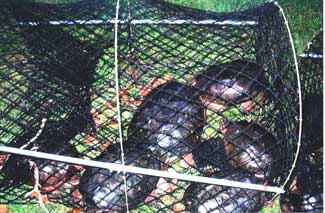
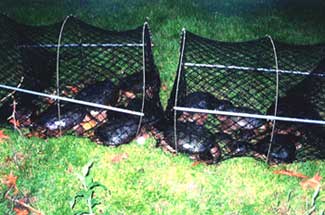
One of the problems facing anyone who wants/needs to trap turtles is the shear size of most of the traps on the market today. Many of them are rigid, and the size of small refrigerators, not to mention that they may cost as much as a couple of hundred dollars or more. The question quickly becomes.... "how many of these can you fit in your service vehicle", and once you're done with them..."where will you store them" ?
The Turtle Trap by WCS addresses both of these items. This fully collapsible turtle trap is made exclusively for WCS and is designed to handle the largest of turtles. The trap when set up measures 30"W x 25"H x 47"L. It has 3 D-Shaped hoops made of spring steel which forms the trap body, this trap won't roll when placed in the water. The net mesh is 2.5" square and is very durable and will give years of service.
The trap comes complete with "spreader" rods to hold the trap in its' rigid set position. It also has a bait bag included in the rear of the trap for ease of setting. PLEASE NOTE: Leave the top 1/4 of the trap exposed above the surface of the water. Turtles need to be able to come up for air, if you completely submerge your turtle trap you will kill the turtles. If you want to catch turtles and don't want to deal with a cage as large as a refrigerator, this trap is the ticket !
BAITING: This trap is very easy to bait. You take the removeable bait bag (included) out of the trap and fill it with small sun fish, suckers, chicken necks, a piece of beef liver, any type of bloody meat. Then tie the bait bag back into the interior center of the trap. The turtles will smell the bait and enter the trap through the large funnel opening, but can't find their way out. When using a large number of turtle traps it is handy to fill all your bait bags ahead of time and then place them in the freezer. When it is time to go catch turtles, simply remove your pre-loaded bait bags from the freezer and you are ready to go turtle trapping.
Monday, July 02, 2007
Groundhog Kokaine
Let me dispel any myths about what it is………..and what it is NOT !
The BASE of "Ghog Kokaine" is in fact horse sweet feed. But it is just that the BASE, not the active ingredient or major attraction. The horse sweet feed is sprayed with a formulation which is provided to us from James White, the inventor. WCS makes the Ghog Kokaine according to the exact directions provided to us by the inventor and we package it in gallons. It is made FRESH as orders are submitted, WCS does not make Ghog Koke and store it, it is a FRESH bait.
Now, all that being said, will horse sweet feed catch ghogs......."probably", but not nearly as effectively or as lasting as the sprayed material. That’s like saying will straight fruit paste catch a squirrel, sure....but not nearly as many or as consistently as when nut oils are mixed with it !! 'nough said !!
Subscribe to:
Posts (Atom)