
Visit us on our new Facebook site. WCS is excited to be part of the ever-growing social networking environment. Visit us here and add yourself as a fan !
http://tinyurl.com/mnvc8h
Extended Validation SSL Certificates are the next generation of SSL certificate. These certificates are meant to combat emerging online threats that continue to erode trust online. Specifically, these certificates will provide a new way for merchants to prove that their site has been verified as an authenticated business. This way your customers will know you are for real and not a phishing site.
All major browsers (e.g. Microsoft, Opera etc) are integrating new displays providing new way for consumers to see a distinct difference between these new EV certificates that confirm a site's identity and non-vetted sites. Users will see a green color change to your site identity indicating that that this site that has been issued an EV SSL certificate.
Here is how IE 7.0 will distinguish between verified sites and phishing sites in 2007
Fig 1, IE7 address bar for a known phishing website detected by the Phishing Filter
Fig 2, IE7 address bar for a site with an EV SSL certificate (showing the identity of the site from the SSL certificate)
Trust is a business imperative that translates into revenue. And these new EV SSL certificates are one of the biggest improvements in your ability to create trust online because users can get browser confirmation of your identity. Comodo was the lead initiator of the CA/B Forum (Certification Authorities and Browsers), an industry group creating the guidelines for the stringent new security standards for SSL certificates. Other members of the CA/B Forum include leading international certification authorities, the major browser providers (including Microsoft, Mozilla, Opera, and Konqueror), as well as the American Bar Association Information Security Committee.
For the first time, EV will provide a uniform vetting standard for all certification authorities so that consumers will be able to make reliable risk assessment decisions about which online merchants to do business with.
And that's why WCS wanted to assure their customers that we take their security when performing online transactions seriously.
Q: How will EV SSL certificates increase consumer confidence?
A: High profile incidents of fraud and phishing scams have made Internet users very concerned about identity theft. Before they enter sensitive data, they want proof that the website can be trusted and their information will be encrypted. Without it, they might abandon their transaction and do business elsewhere. EV SSL Certificates provide third-party verification using a highly visual display that gives consumers confidence and builds trust in e-commerce.
Q: How is a consumer expected to distinguish between the different type of SSL certificates?
A: The presence of a verifiable High Assurance SSL certificates provides reassurance to consumers. Low assurance certificates, by contrast, are not inherently trusted by browsers and will cause some browsers to display "warning messages" informing the user that the certificate has not been issued to a verifiable entity. Loss of trust equals loss of sales whereas increased trust results in increased sales.
Q: What are the benefits of EV SSL certificates to Web site owners?
A: An EV SSL Certificate helps visitors complete secure transactions with confidence because your site has the "green bar" in IE 7 and your competitor's site does not. You appear to be more trusted and more legitimate. That's a competitive advantage that translates into higher conversion and more revenue. And it's why you are in business.
Q: Why do I need an EV Certificate on my site?
A: Today's fastest growing threat is phishing, where a fraudulent web site impersonates a legitimate business to attract unsuspecting visitors into divulging personal information. The increasing awareness to this problem has caused consumers to not trust buying online.
Your board is not sitting back hoping they will just go away. We are working on some things to counteract their actions. This all takes time and money (Serious Money!). This will be an effort by all organizations effected by any such initiative, and believe me there are many that will be effected. We are working toward getting everyone on board to fight this war. I will not go into detail on what we are working on, because who knows who might read this. If you would like to find out more, feel free to give any director or myself a call.You can contact Tom at 406-683-2791 or t_barnes@wmc.edu.
BE IT ENACTED BY THE PEOPLE OF THE STATE OF MONTANA
AN INITIATIVE CALLED THE MONTANA TRAP-FREE PUBLIC LANDS INITIATIVE PROHIBITING TRAPPING OF ANIMALS ON PUBLIC LAND WITHIN THE STATE OF MONTANA EXCEPT FOR SCIENTIFIC OR PROPGATION PURPOSES AND PROVIDING AN IMMEDIATE EFFECTIVE DATE.
Be it enacted by the people of the state of Montana:
NEW SECTION. Section 1. Short title. [Sections 1 through 3] may be cited as the Montana Trap-Free Public Lands Initiative.
NEW SECTION. Section 2. Findings. The people of the state of Montana find as follows:
1. Animal trapping poses significant financial threats to Montana's tourism revenue stream. An estimated two hundred fifty million to three hundred million dollars per year flow into our state from wildlife watching activities. The direct loss of wildlife due to trapping, as well as the unfavorable public opinion of such activities, poses a direct threat to this revenue source.
2. Animal trapping is largely unregulated in Montana. There are no limits to the number of traps a trapper may set, and thus, no limit to the number of animals taken each year. No data exist as to the population numbers or overall health of any of the animal species being trapped. Montana is in danger of decimating its wildlife populations through trapping.
3. The ethical implications of trapping are very disturbing. The suffering inflicted upon so many species in the name of recreation and profit is astounding. The people of Montana have too much respect for the wildlife within their state to allow such activities to continue.
4. Montana's public lands should be open to all people. By placing such hazardous and indiscriminate devices on our public lands, the trapping community is putting others, as well as their companion animals, at constant risk. The people of Montana have a right to recreate on public lands without fear of injury to themselves or their pets from such devices.
Section 3. Section 87-2-103, MCA is amended to read:
License required. (1) Except as provided in subsection (2), it is unlawful for a person to:
(a) hunt or trap or attempt to hunt or trap any game animal, any game bird, or any fur-bearing animal or to fish for any fish within this state or possess within this state any game animal, game bird, fur-bearing animal, game fish, or parts of those animals or birds, except as provided by law or as provided by the department; or
(b) hunt or trap or attempt to hunt or trap any game animal, game bird, or fur-bearing animal or fish for any fish, except at the places and during the periods and in the manner defined by law or as defined by the department; or
(c) hunt or trap or attempt to hunt or trap any game animal, game bird, or fur-bearing animal or fish for any fish within this state or possess, sell, purchase, ship, or reship any imported or other fur-bearing animal or parts of fur-bearing animals without first having obtained a proper and valid license or permit from the department to do so; or
(d) trap or attempt to trap predatory animals or nongame wildlife without a license, as prescribed in 87-2-603, if that person is not a resident as defined in 87-2-102; or
(e) trap or attempt to trap wildlife, game, and nongame animals on public lands in Montana except as allowed under 87-2-806 MCA or 87-2-807 MCA.
(2) The provisions of this section do not require a person who accompanies a licensed disabled hunter, as authorized under 87-2-803(4), to be licensed in order to kill or attempt to kill a game animal that has been wounded by a disabled hunter when the disabled hunter is unable to pursue and kill the wounded game animal. However, the person must meet the qualifications for a license in the person's state of residence.
NEW SECTION. Section 4. {standard} This act is effective upon approval by the electorate.
NEW SECTION. Section 5. Submission to electorate. {standard} This act shall be submitted to the qualified electors of Montana at the general election to be held in November 2010 by printing on the ballot the following:
Statement of Purpose (100 words)
This initiative prohibits trapping of wildlife, game and nongame wildlife, including furbearers, wolves and predators, by any means on any public lands within the state of Montana, except as allowed for scientific or propagation purposes.
Statements of Implication (25 words)
[] FOR prohibiting trapping of animals on any public lands within the state of Montana.
[] AGAINST prohibiting trapping of animals on any public lands within the state of Montana.

Announcing Trappers Post, a bi-monthly magazine devoted exclusively to trapping. Published and edited by Bob Noonan. Trapper’s Post will be a bi-monthly magazine of tabloid size (11x12-inch). The first issue will be September/October 2009.
For more information and to subscribe go to: www.trapperspost.com
The Three Bears? Try 163,000 ... and counting
4 days ago
HARLAN, Ky. (AP) — Bobby Koger was deer hunting on a Kentucky hillside when a black bear gave him the fright of his life.
A 300-pound animal, apparently unhappy that an intruder was on his turf, came charging and didn't stop until Koger raised his .50 caliber muzzleloading rifle and fired from point-blank range. A hunting companion who witnessed the attack from a distance also shot the bruin, which wheeled, ran a short distance and collapsed.
Conservation officers concluded that they fired in self-defense at a bear that had lost its natural fear of humans.
With black bear populations rising, run-ins have become almost commonplace — more than 15,000 in the past year in states east of the Mississippi River according to a survey of state wildlife agencies.
Canadian bear researcher Hank Hristienko, who conducted the survey in January, found that 18 Eastern states were seeing more encounters with bears.
Most encounters involve hungry bears raiding backyard bird feeders or toppling garbage bins, but sometimes they're harrowing. In a 2006 attack, a 210-pound male bear killed a 6-year-old girl and mauled her 2-year-old brother as well as her mother who tried to fend off the animal. The attack occurred during a family outing in Tennessee's Cherokee National Forest.
Some bears have become brazen, dining beneath backyard fruit trees, raiding pet food bowls, even chasing campers. At a park near Prestonsburg, Ky., last year, a bear held tourists at bay inside a cabin until rangers arrived to chase it away.
They have also become road hazards. Wildlife agencies reported more than 1,300 struck by automobiles in 2008.
The U.S. bear population more than doubled between 1989 and 2006, rising from 165,000 to over 350,000, according to The International Association of Bear Research and Management, a bear conservation nonprofit that takes a periodic census of the animals. The Eastern states alone now have about 163,000 bears, according to findings Hristienko released in May.
Biologists with the same group found nearly 20,000 reported conflicts between bears and humans in 37 states in a 2006 survey of state wildlife agencies.
More recently, in the Eastern region alone, 18 states reported an increase in bear-human conflicts over the past year, Hristienko found in his survey of wildlife agencies.
Tennessee reported the largest increase, up from 300 to 1,000 over the past 10 years. That was followed by New York, which went from 587 to 1,127, and New Jersey, which jumped from 691 encounters to 1,117.
Frank van Manen, a U.S. Geological Survey research ecologist and president of the International Association for Bear Research and Management, said it's not that the bears are becoming more aggressive. Instead, he said, bear populations are skyrocketing under state bans or limits on bear hunting.
"What we have seen throughout the eastern United States is quite a phenomenal range expansion of the black bear," van Manen said. "With the range expansion, the likelihood of the encounters is increasing."
Black bears are the most common bear species in the U.S. with measurable populations in most states. Their larger cousin, the grizzly, is limited to the northwestern states and Alaska. They eat just about anything, including meat, but tend to subsist mostly on insects, nuts, berries, acorns and other vegetation.
Stephanie Boyles, a wildlife scientist for the Humane Society of the United States, said 14 people have been killed in attacks by black bears in North America since 2000, including two in Tennessee in the Great Smoky Mountains National Park and the Cherokee National Forest. Boyles said another 10 people were killed by grizzlies during the period, mostly in Alaska and Canada.
In Kentucky, officials opened a hunting season for bears, a move pushed by the state League of Sportsmen to reinforce the animals' fear of humans.
More than a century ago, bears thrived in Kentucky, but over-hunting and habitat loss led to their disappearance. As the large animals have ventured back from neighboring states, Kentucky residents nowadays find themselves unaccustomed to living among bears.
"You've got bears moving into areas where people live and you've got people moving into areas where bears live," said Mark Ternent, a state bear biologist in Pennsylvania. "Both of those scenarios frequently involve people with little experience living around bears."
Ternent said most of the encounters are harmless, ending with the bears running away.
"The average bear is afraid of people," he said. "If it encounters a person, it would rather flee than fight."
Boyles said people can prevent unwanted bear encounters by doing simple things like putting bird feeders out of reach of the animals, putting trash out only on the day it is to be picked up, and keeping pet food indoors.
Koger, a construction worker, said he has run across lots of bears over the years in the mountains of eastern Kentucky. Most of the time, he said, the bears don't relish the encounters either.
"Usually they want to get away from you as much you want to get away from them," he said. http://www.google.com/hostednews/ap/article/ALeqM5jW8Az6dNM2XOhDW1ew8OEEji-MuAD98Q4B6G0
Wildlife Control Supplies is happy to announce that on Friday 6/12/09 we go live with a new and improved web store! For the past few months we have been working diligently on the new site in order to better satisfy the needs of our customers and increase the convenience of shopping with us. You can still access us at www.wildlifecontrolsupplies.com or www.shopwcs.com.
New features like customer selectable searches (e.g. by price, by name, best sellers, arrivals), the latest "new items" will be listed on our home page and more user friendly categories are some of the new enhancements. For those customers who have set-up a login and password on our old site, that login information has been moved to the new site. For customers who have or establish an account with a login and password, order history moving forward will be captured for future reference.
We hope that you find our new site easier to navigate and that your shopping experience is better than ever! As always, we value your feedback. Once online, let us know how you like our new site. We will continue to add enhancements to make shopping with us easier and convenient.
Wildlife Control Supplies!
FAIRFAX, Va. — The National Pest Management Association (NPMA) has announced the line-up of keynote speakers for its 76th Annual PestWorld Convention & Exhibition.
Speakers include Christopher Gardner, the inspiration for the film The Pursuit of Happyness, and Bob Pritchard, a global marketing expert.
NPMA PestWorld 2009 will be held Oct. 26-29 at The Venetian Palazzo Resort-Hotel-Casino in Las Vegas.
The PestWorld 2009 program of events and conference registration are now available online at www.npmapestworld.org/events.

Published: Sunday, May 31, 2009 Associated Press (bold ours)
HARTFORD — The Connecticut General Assembly won't take up a bill this session banning a long list of wild and potentially dangerous animals as pets.
The legislation stems from the February attack on a Stamford resident mauled by a 200-pound chimpanzee.
Rep. Richard Roy, co-chairman of the legislature's Environment Committee, said that the bill is being abandoned because some lawmakers want to protect a family-owned elephant farm in Goshen.
Many state politicians were outraged that potentially dangerous animals were allowed as pets after learning of the chimpanzee attack on Charla Nash, who lost her hands, nose, lips and eyelids in the assault. But Roy said Goshen-area lawmakers fought the bill.
"It's dead because there's a piece that was put into the bill that would have not allowed the Commerford family to bring in any new elephants in the years ahead, thereby, essentially closing the business down," he said. The farm has several elephants, a petting zoo and a variety of exotic animals, including zebras and camels. Commerford brings the animals to fairs and malls along the East Coast. "The Commerford Farm is a community fixture up in Goshen and it would be sad to see that business have to terminate what it does as it moves into the future," said Rep. Roberta Willis, D-Lakeville.
Even though the legislative session ends on Wednesday, Roy said it won't be brought up because the debate will take up too much time.
Sen. Andrew McDonald, D-Stamford, was surprised by the bill's demise. The legislation has been supported by the Attorney General and the Department of Environmental Protection. The DEP will be hosting an exotic animal amnesty day in July to persuade residents to turn in their illegal and legal exotic pets.
"The legislation is extraordinarily important and I understand that there were concerns expressed by some legislators, but there's certainly no excuse for not coming up with a reasonable compromise that would assure the safety of the people of our state," McDonald said.
Besides the Commerford dispute, the legislation also faced challenges from lawmakers who wanted to propose various amendments, such as grandfathering existing exotic animals to legalizing bow hunting on Sundays. http://www.nhregister.com/articles/2009/05/31/news/b8-animalban.txt
This bill H.B. No. 6552 (RAISED) ENVIRONMENT. AN ACT BANNING THE POSSESSION OF POTENTIALLY DANGEROUS ANIMALS AND THE IMPORTATION, POSSESSION AND LIBERATION OF WILD ANIMALS. Title changed from 'AN ACT BANNING THE SALE OR USE OF COMPUTER SOFTWARE OR SERVICES TO REMOTELY OPERATE WEAPONS TO HUNT ANIMALS OR BIRDS'. CCS opposed the "Computer Hunting" and supported the "Dangerous Animals" bill. Of the 14 amendments, the first two applied to the bill. When it was reported the Senate refused to debate S.B. No. 650 AN ACT CONCERNING THE CREATION OF A TRUST FOR THE CARE OF AN ANIMAL. which had S.B. No. 994 AN ACT CONCERNING LEGHOLD TRAPS attached as an amendment, after the bill failed in Judiciary Committee, the Leghold Trap Amendment was then proposed on the Dangerous Animals bill in the House. Both House and Senate Amendments were sponsored by the Chairmen of Environment Committee REP. ROY, 119th Dist. & SEN. MEYER, 12th Dist. The amendment on the Dangerous Animals bill, we felt, was a direct affront to DEP by placing an amendment which DEP opposed on a bill DEP wrote and supported. This amendment, we believe, effectively killed the "Dangerous Animals" bill when it was proposed. Pro-sportsmen legislators then responded by submitting amendments on Sunday Hunting. Then the anti-hunting frivolous amendments began (extracted from separate amendments): the arrow shall be labeled with the hunter's name and license number.; (a) (1) No person shall carry a pistol, revolver, machine gun, shotgun, rifle or other firearm, which is loaded and from which a shot may be discharged, upon his person (A) while under the influence of intoxicating liquor or any drug, or both, or (B) while the ratio of alcohol in the blood of such person is [ten-hundredths] three-hundredths of one per cent or more of alcohol, by weight. ; (c) A person hunting on private property pursuant to subsection (b) of this section shall ensure that any arrow such person shoots from a bow with a draw weight of not less than forty pounds does not leave such private property.; and A person hunting on private property pursuant to this subsection shall obtain the written consent of the owner of such private property, or of such owner's authorized agent and from the owners of all private property within a five-mile radius of the property such person intends to hunt on, or from such owners' authorized agents. – All submitted by REP. HORNISH, 62nd Dist. These same amendments with more co-sponsors are also proposed on H.B. No. 6553 AN ACT CONCERNING SUNDAY HUNTING.
The Senate bill was passed without the Trapping amendments, and we agree with Rep. Roy that the "Dangerous Animals" bill will not be addressed. The same can probably be said for the Sunday Hunting bill for the same reasons. However, we will continue to be watchful. Your communications helped tremendously to defeat this and other bills.
Remember, Nothing is ever Dead until the end of the session.
The session ends this Wednesday, June 3, at midnight.
Speaker of the House Christopher Donovan
860 240 8500
House Majority Leader Denise Merrill
860 240 8500
Representative Richard Roy
860 240 8500
Representative Brian Hurlburt
860 240 8500
House Minority Leader Larry Cafero
860 240 8700
You can find your CT legislator at http://www.cga.ct.gov/maps/townlist.asp or in the Blue pages under “
While we urge you to use your own words, use the KISS principle, and please…do not be insulting or negative towards Any Senator, Representative, or anyone else in the Capitol. Identify yourself and Town, State your position and why you Support or Oppose the bill. Be Brief, if they have questions they will ask.
Review all current bills and other info at the CCS website www.ctsportsmen.com
Senator Meyer and Representative Roy has attached the original context of SB #994 and their proposed amendment to SB #650: AN ACT CONCERNING THE CREATION OF A TRUST FOR THE CARE OF AN ANIMAL.
http://www.cga.ct.gov/asp/cgabillstatus/cgabillstatus.asp?selBillType=Bill&bill_num=650&which_year=2009
We must again, contact our Legislators and oppose SB #650 with the
specific mention that the final Fiscal Note :
http://www.cga.ct.gov/2009/fna/2009SB-00650-R00LCO06716-FNA.htm
which has a price tag of close to $500,000 per year for the next two (2) years.
April 16, 11:16 PM
S.B. 994, An Act Concerning Leghold Traps, proposes to ban the use of leghold and Conibear traps in Connecticut. The original note on the fiscal impact of the law indicated that there would be minimal effect. The Office of Fiscal Analysis (OFA), however, has now corrected that initial assessment, based in part on an analysis of the experience of Massachusetts in struggling with its 1996 trapping ban.
The predicted cost to the state in lost revenues is estimated at $15,464 per year due to the loss of trapping licenses through the Department of Environmental Protection (DEP).
The estimated cost to the state in additional expenses associated with nuisance-animal management is $482,000 in fiscal years 2010 and 2011.
The estimated additional cost to Connecticut municipalities for nuisance-animal control is $92,000, as the services of volunteer trappers would no longer be available to Connecticut towns for the removal of problem beavers, and the towns would thus need to employ professional trapping companies.
The OFA cannot estimate other likely costs of the proposed trap ban: flooded basements, damaged roads, and contaminated drinking water due to flooding from beaver dams; increased damage to corn crops by raccoons; additional poultry losses to foxes and fishers; the loss of family pets to coyote predation. The list goes on and on.
Bad wildlife management is expensive. We might hope that the Humane Society of the United States, the key lobbyist for S.B. 994, will be willing to cover the costs if the law passes. But we all know that won’t happen. Connecticut taxpayers will get stuck with the bill.
News article by Jeff Serena from the Examiner.Com
S.B. 994, An Act Concerning Leghold Traps, is making its way toward consideration in the General Assembly. It originated in the Environment Committee with the effective lobbying of the Humane Society of the United States (HSUS) in direct response to the highly publicized, ultimately fatal trapping of a great horned owl in January 2009. The trap in that incident was a leghold trap. Although the trap was illegal (unpadded, not offset, not anchored, anonymously set), and in such poor and rusted condition that it could not be made to work when tested later, it nonetheless provided sufficient ammunition for anti-trapping activists to set in motion a bill to ban leghold traps.
But a funny thing happened on the way to the General Assembly. By legislative sleight-of-hand, the Act Concerning Leghold Traps also includes language to ban Conibear traps. Conibears aren’t leghold traps. What are they doing in S.B. 994?
The Conibear trap is a killing trap. It’s known generically as a “body-gripping trap” among trappers and wildlife biologists, as a “body-crushing trap” among animal-rights activists, and as a “smooth wire trap” in the Connecticut trapping regulations. The Conibear trap is named for its inventor, Frank Conibear. A well-known professional trapper and wilderness guide in Canada’s Northwest Territories, Conibear retired from the field in 1944 and began working on a design for a new trap that would kill a trapped animal quickly, rather than holding it alive until the trapper arrived to dispatch it.
By the mid 1950s, Conibear had his new trap. It’s a deceptively simple device that works much like a mousetrap. Two spring-loaded metal frames form an opening into which an animal is guided or lured. As the animal puts its head into the trap, it trips a trigger that snaps the frames together on the animal’s neck or upper body, killing it. Death generally occurs instantly due to a broken neck or dislocated spine, or very rapidly due to physical trauma and drowning. The Canadian Association for the Protection of Fur Bearing Animals provided financing for Conibear’s new device, which quickly gained popularity as an efficient and humane trap. In 1961, the American Humane Association awarded Frank Conibear its Certificate of Merit for his invention.
In Connecticut, Conibear traps can only be legally set in the water. They are, therefore, used exclusively for trapping aquatic furbearers—large traps for beavers and river otters, and smaller traps for muskrats and minks. Although a trap set specifically for a beaver may occasionally catch a legal otter or muskrat, Conibears set in the water are extremely selective in excluding non-target animals, such as deer, birds, bobcats, and dogs.
Because they’re fast-killing and highly selective, Conibears pose a special challenge to anti-trapping activists. It’s easier to get a trap banned if you can plausibly argue that it causes a slow, agonizing death, or that it threatens pets or children or endangered species. As used by trappers in Connecticut, the Conibear trap plainly doesn’t do any of those things. And that’s why it’s in S.B. 994. There’s currently no practical way to get the Conibear trap banned on the merits, no matter how often you misinform people about it. But with public hackles up about the unfortunate owl, and a statewide ban on legholds a real possibility, you can slip the Conibear trap into the bill and reasonably hope that no one will notice. The trick may work, but it’s not a way to responsible or effective wildlife management.
Fonfara took his name off the sponsors list of SB 994. His office said he changed his mind!!!!
Way to go 1st district trappers!! Keep up the good work!
A short msg. of thanks to Mr. Fonfara is in order too!
March 23, 1:47 PM
S.B. 994, "An Act Concerning Leghold Traps,"
<> has been
approved by a vote of 22-8 in the Connecticut General Assembly's Environment Committee, and will now be considered by the legislature. If enacted, the law will largely ban the use of leghold and Conibear traps in the state.Proponents of the measure argue that passage of S.B. 994 will finally end an unacceptably cruel practice. Opponents argue that trapping is not inhumane,and that it is an important tool for wildlife management in Connecticut.In 1996, voters in Massachusetts approved an anti-trapping ballot referendum expertly pushed by animal-rights organizations. Formally titled the Wildlife Protection Act, the law is more popularly known as Question One. Like S.B.994, Question One bans the use of leghold and Conibear traps. The Massachusetts experience, particularly with regard to management of the state's beaver population, is a useful case study for understanding the practical implications of S.B. 994.Prior to Question One, Massachusetts had a healthy beaver population estimated at approximately 23,000 animals. Homeowners and others dealing with occasional beaver problems, such as the destruction of trees and the flooding of yards and basements, could call MassWildlife <http://www.mass.gov/dfwele/dfw/> , the Massachusetts agency that is roughly the equivalent of the Wildlife Division of Connecticut's Department of Environmental Protection (DEP). MassWildlife would typically refer the caller to the Massachusetts Trappers Association. The MTA would recommend a trapper, who would come out during the trapping season, generally at no cost to the landowner, and kill the beaver.As in Connecticut, most Massachusetts beaver trapping was done with Conibear traps set in the water. Conibears are not leghold traps. They are lethal traps that work on much the same principle as the familiar mousetrap. A beaver is guided or baited into putting its head into the trap, triggering stiff wire arms that snap down on the animal's neck, dislocating the
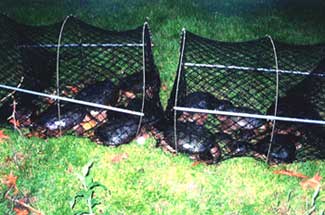
beaver's spine and killing it.Question One banned Conibears but not "humane" box traps and suitcase traps.In Massachusetts, these traps are used to capture beavers alive and unharmed so that they can be killed later. Relocating beavers is illegal in Massachusetts. Box traps and suitcase traps make trapping, which is demanding work in the best of circumstances, even more difficult. They're
bulky, heavy, and time consuming to carry and set. They're also expensive,and with the market for furs so depressed, it's hard for a trapper to
justify replacing his Conibears with cage traps that may well cost more
money than a successful trapper will realize from the furs he takes in a
whole season's trapping.
The ban on Conibear traps very nearly ended fur trapping for beavers in
Massachusetts. In the last trapping season before the ban took effect,
trappers harvested 1,136 beavers in the state. By the 1997-98 season, the
number of beavers killed by trappers had dropped to ninety-eight.
Animal-rights organizations hailed the passage of Question One as a signal
victory for their cause. Then things began to get complicated.
Suddenly relieved of the pressure of its main predator, the beaver
population in Massachusetts grew explosively. By 2000, the population was
estimated to have tripled to about 70,000 animals. As the beaver population
increased, reports of damaged private property, blocked culverts, and
flooded roads due to beaver activity skyrocketed. Public water supplies in
towns like Sterling
<http://www.wwdmag.com/River-Contaminates-Town's-Water-Supply-When-State-Lea
ves-It-to-Beavers-article3199> and Chelmsford
<http://www.fishwildlife.org/furbearer_cases.html> were contaminated by
flooding caused or exacerbated by beavers.
Massachusetts had long had some problem beavers, but beavers were now a
widespread problem. As environmentalist firebrand Ted Williams wrote
<http://list.audubon.org/wa.exe?A2=ind0501&L=audubon-pa&P=77> in Audubon
magazine, "We've converted a resource to a pest."
The 1996 passage of Question One, which banned the use of leghold and
Conibear traps in Massachusetts, led to a dramatic increase in the state's
beaver population. By 2000, beavers had become serious pests, and their
activities were flooding highways, contaminating drinking water, and causing
extensive damage to private property.
In 2000, the Massachusetts legislature responded by modifying Question One
to allow local boards of health to issue emergency permits for the use of
Conibear traps, not just during trapping season but at any time of year, to
destroy beavers that pose a threat to human health and safety. This action
completed a fundamental shift in beaver management that had begun with
Question One four years earlier. Instead of actively managing the beaver
population strategically and across the state, Massachusetts now manages
beavers reactively through local damage control in an endless series of
small crises. With much of the state's beaver control now in the hands of
town health boards with no reporting requirements back to the state,
MassWildlife, the agency ostensibly responsible for wildlife management in
Massachusetts, can no longer even accurately estimate the size of the
state's beaver population.
Massachusetts homeowners once had their beaver problems resolved largely by
recreational fur trappers-at no cost. Now many homeowners pay nuisance
animal control operators hundreds of dollars, and sometimes more, for
trapping, fencing, tree wrapping, and the installation of flow-control
devices in beaver ponds. Massachusetts taxpayers have also taken a financial
hit, as highway departments and towns pay for beaver-control services.
Additional concerns about the growing beaver population have arisen,
including an increase in mosquito breeding habitat and a possible link to
mosquito-borne diseases like West Nile Virus.
And what about the beavers? Because of the large number of problem beavers
now being trapped for damage control, it's estimated that the number of
beavers being killed annually by trapping in Massachusetts (based on 2006
data, which are the most recent available) is higher than the number killed
before Question One.
When good technology managers consider purchasing a new hardware or software
product for their company, they make certain that the product has been
subjected to adequate beta testing to ensure that it will work in their
operating environment. As the General Assembly considers S.B. 994
<http://www.cga.ct.gov/2009/TOB/S/2009SB-00994-R00-SB.htm> , it needs to
look at Question One. Massachusetts has, in effect, done the beta testing
for Connecticut's proposed trap ban. The results couldn't be clearer. It
doesn't work.
When I began looking into the issues surrounding S.B. 994, I was about as
neutral as a person can be on an extraordinarily polarizing subject. Since
then, I've spent many hours reading about trapping: scientific papers, news
stories, blogs, and a lot of anti-trapping literature. I've spoken and
corresponded with trappers, wildlife biologists, and animal-rights
advocates. I've been privileged to meet thoughtful, gracious, helpful folks
on all sides of the debate. And I'm not neutral anymore. S.B. 994 is
flat-out bad legislation.
The people who are providing the main impetus for S.B. 994 surely have good
intentions. The Humane Society of the United States <http://www.hsus.org/>
(HSUS) is the key lobbyist for the trap ban. HSUS is a smart organization
that does much good work on behalf of animals. No one should confuse them
with groups on the lunatic fringe <http://www.petakillsanimals.com/> of the
animal-rights movement. Even folks who vehemently disagree with HSUS on
policy matters should still recognize that the organization's local staff
and volunteers are sensible people who genuinely care about Connecticut and
its wildlife.
Senator Ed Meyer <http://www.senatedems.ct.gov/Meyer.html> led the charge
for S.B. 994 in the Environment Committee, and seems likely to perform the
same role in the General Assembly. Senator Meyer represents the 12th Senate
District <http://www.cga.ct.gov/red/2001senate.htm> , where I happen to
live. He's a good man-an effective legislator who works hard on behalf of
his constituents and the people of Connecticut. I've voted for him twice,
and I hope to do so again. But even good legislators and smart organizations
sometimes make mistakes. S.B. 994 is a mistake. It will be best to tell them
so.
http://www.examiner.com:80/x-4401-Connecticut-Nature-Examiner~y2009m3d23-Bet
a-testing-SB-994-Connecticuts-proposed-fur-trapping-ban-Part-1
Support Your fellow sportsmen:
"We must, indeed, all hang together or, most assuredly, we shall all hang
separately".
Benjamin Franklin
<http://www.brainyquote.com/quotes/quotes/b/benjaminfr151597.html>
http://www.brainyquote.com/quotes/quotes/b/benjaminfr151597.html

See a brief video clip of "How to Set the NoMol Trap" from the complete production
MOLES: Removal made Simple. Just posted on YouTube:
http://uk.youtube.com/watch?v=MZE6qoEA73A
Short video clip of the Collarum "In Action" at the National Wildlife Research Center in Denver


Tube Trap Customer Wrote:
Hi Alan I dont think anything less than my sample would be strong enough to absorb the huge impact. If you could get tubing just as hard as the sample that I am mailing it could work. Feel free to use what I tell you any way you want. If you make a million send me a box of double spring Koro traps. Please find attached the picture you requested. Also the rubber is held in place with two nuts and bolts. The rubber should be about a 1/4 inch up the slot so when it fires it wont bottom out and bend the rod. I don't know where you could get this rubber. I have a roll of it that was used to make pads for railroad track plates. Yes I am retired but if you want I could send it to you. Its quite heavy.
I will put the sample in tomorrows mail.
Bill Lane
I thought folks might like to see this, a suggestion in from a customer on the TUBE TRAP. Just a note here……you should NOT DRY FIRE TUBE TRAPS as you would perhaps a bodygrip or foothold trap.
********************************************************************************
Hi Alan: Recently you were good enough to replace some Tube Traps that were damaged due to Dry Firing.
Well thank you very much !
I felt a little guilty taking them but have now figured a way to try and pay you back.
Please find attached some pictures of what I think is the answer to the problem. The rubber pad is meant to absorb the shock of any Dry Firing.
Also I figured how to straighten the kill rod after it gets bent.
I put the tube trap on my work bench and put a long screw driver on the inside of the trap and on the rod. With a lump hammer I give it a couple of shots and the rod returns to its original straightness. Simple but it took me a long time to figure it out.
The screw driver has to go thru the trap in the kill rod slot
Thanks Again
Bill Lane
Heres a testimonial we recently received on our NEW DVD titled "Beaver: Live Trapping Techniques"
Guys,
Our IADCA Association just bought your DVD as a giveaway in the raffle at our next meeting on Aug. 11. Since I bought it for the association I thought I should preview it to make sure it is acceptable for the members to view… ha ha. I must say you guys have produced the absolute best instructional DVD that I have ever seen. The photography and information presented is very clear and concise. Anyone buying this DVD to learn the equipment and techniques should be able to go right out and do a good job at live beaver trapping. That is quite unlike it was 14 years ago when I bought a two Hancock traps and had to learn by the “seat of my pants” including how to set the traps safely.
You guys have set the standard for instructional information and one can only hope that others will take the cue from you.
Thank you, Tim Christie, Wildlife Management Services

