Wednesday, September 09, 2009

Disinfect with Nisus DSV


Flu Could Infect Half of USA
90,000 Deaths, 2 Million Patients Possible
-USA Today,Aug. 25, 2009

The media loves to sensationalize !
Never mind that swine flu appears to be less virulent than normal flu. And if you read the article, the actual estimate is 30,000 to 90,000. In fact, nowhere did the article mention that currently more than 30,000 people die from regular influenza every year in the USA. But the media influences our customers, and more and more and more companies are taking steps to slow the spread on influenza - and that's a good thing !

Be Part of the solution:
Disinfect with Nisus DSV:

Nisus DSV is a disinfectant, sanitizer and virucide that allows you to provide sanitizing service to residential and commercial accounts. DSV meets AOAC efficacy standards for hard surface non-food contact sanitizers. DSV is effective against bacteria including E-coli, Staph, Salmonella, and Strep, as well as viruses including HIV, Influenza, Hantavirus, Avian Flu, and Hepatitis B & C. In fact, DSV can be used against all type A influenza viruses, which include the H1N1 virus (swine flu).

DSV can also be sold directly to your residential and commercial customers for use in schools, nursing homes, hospitals, restaurants and 245 other locations.

One Gallon of DSV makes 64 gallons of solution.

Friday, August 28, 2009

Letter from Senator Chris Dodd on Concealed Carry Reciprocity Bill

August 10, 2009
Mr. Robert Crook
408 Copse Rd
Madison, Connecticut 06443

Dear Mr. Crook:
Thank you for contacting me regarding concealed-carry reciprocity legislation. I appreciate hearing from you on this important issue.

I understand your concerns regarding gun control. I recognize that responsible gun ownership has long been part of America's heritage. However, I also firmly believe that it is the obligation of government to pursue responsible policies that protect innocent Americans, particularly children, from gun violence. In my view, far too many people are killed or seriously injured by guns each year. Data from the National Center for Injury Prevention and Control indicate that in 2006, there were 30,896 deaths resulting from gun-related incidents, including 4,064 deaths of persons who were under the age of 21 and 185 deaths of children under 12 years of age. Throughout my career in public service, I have chosen to support gun safety legislation that balances the need to keep our communities safe with the legitimate interests of law-abiding gun owners.

As you know, during Senate consideration of S. 1390, the National Defense Authorization Act for Fiscal Year 2010, Senator John Thune (R-SD) offered an amendment that would have allowed individuals who are licensed to carry concealed firearms in their own states to do so in other states where this practice is legal. Ultimately, this amendment failed to garner the three-fifths majority it needed to pass. Please be assured that I will keep your views in mind should similar legislation be considered by the full Senate in the future. [He voted against it, lost by two votes.]

Thank you again for contacting me. If you would like to stay in touch with me on this and other issues of importance, please visit my website at http://dodd.senate.gov and subscribe to receive my regular e-mail issue alerts. Please do not hesitate to contact me again if I may be of assistance to you in any way.

Sincerely,
CHRISTOPHER J. DODD
United States Senator


Saturday, August 08, 2009

NEW CT Hunting & Trapping Regulations

On Wednesday, July 29, 2009, the Legislature's Regulations Review Committee approved the DEP regulations package affecting hunting, trapping and falconry. The regulations will be effective upon filing with the Secretary of the State.

As a reminder, the new regulations will:
1) Eliminate the interview process for physically disabled persons to obtain a crossbow permit;
2) Eliminate orange requirements for bowhunting on state lands that are designated as archery-only;
3) Allow crossbows on private lands in Deer Management Zones 11 and 12 during the January season;
4) Remove the 3 shell limit for hunters during the September goose season;
5) Eliminate the season bag limit on beaver and extend the trapping season to March 31;
6) Move the fisher trapping season to December and increase the season bag limit from 2 to 4;
7) Move the spring turkey season forward by one week to start on the last Wednesday in April;
8) End the spring turkey season on the last Saturday in May;
9) Allow spring turkey hunters to obtain both a state land and private land permit;
10) Establish a second junior turkey hunting training day and extend the hunting hours on junior turkey hunting training days to 5:00pm;

11) Extend the private land muzzleloader deer season to the end of December;
12) Create a second junior deer hunting training day;
13) Allow deer hunters on private land to use a bow during the shotgun/rifle season;
14) Accommodate automated licensing regarding the tagging of deer and turkey and methods of reporting harvest; and
15) Amend the falconry regulations to redefine hybrid raptors the same way that the federal laws do, to change the permit duration and reporting requirements to a June-July calendar year, and to change the fee for a non-resident falconry permit from $75.00 to $14.00 annually.


Monday, July 27, 2009

EarthCare Kills Dead Rodent Smells

If you are like most Pest Control Operators, you want to be able to use an odor control product that will work on everything.  The EarthCare Bags are a proven system for eliminating odors of all types.  Don't take our word for it - watch what this Professional Pest Control Operator from Iceland has to say.
Click on the link or video below.  When your done learn what other have to say at the end of this email.
http://www.youtube.com/watch?v=7Jty7J4JsiA

Over the past 17 years, EarthCare Products have solved thousands of odor challenges from dead rodents to skunks to nasty urine odors.
Pest Control Operators having tried many other solutions in the past without success are elated after trying EarthCare with the results they've achieved. 
#

Friday, July 24, 2009

Habits Of Successful Twitter Users

photo credit: respres

Incorporate these traits, or habits, into your twittering and you'll be sure to be a more popular Twitterer. For an all around better time Tweeting, be quick to follow users exhibiting these traits!

Small Biz Bee suggests promoting other users more than you promote yourself on Twitter. By promoting people other than yourself you create a larger sense of trust in the community you broadcast to.

Since Twitter revolves a lot around conversation, always make sure to join in on the conversation. Contribute to others posts with comments, reply to comments made on your posts, provide helpful tips and suggestions where needed.

Listen before speaking. This is almost like the "think before you speak" concept. Before you start plugging away at the posts and comments, listen to what others have to say first and then contribute where you can.

From Business Opportunities Weblog.


--
This article was sent using my Viigo.
For a free download, go to http://getviigo.com


Sent from my Verizon Wireless BlackBerry

Monday, July 20, 2009

WCS Now Offers "Green" Snake Fence

EAST GRANBY, Conn. — Ideal for preventing snakes from entering protected areas, the Snake Fence acts as a deterrent and trap at the same time. While shielding snakes from your garden, patio, pool, or even where children might play, the snake that tries to crawl through the Snake Fence will be caught in the mesh. Designed to blend into landscapes, the Snake Fence is extremely durable, requires minimum maintenance, and can be used in various terrain.

There are three different models for the Snake Fence. Each model is 12 inches tall and is offered in either 10 or 25 foot sections. Each model is designed for different snakes, and the dimensions of the mesh are as follows:
Copperhead Snake: ¾ inch mesh; will also hold large water snakes, black snakes, corn & milk snakes. Coral Snake: ¼ inch mesh; also for garter snakes and all smaller sized snakes. Rattlesnake: ¾ x 1 ½ inch mesh; meant for larger snakes.

The Snake Fence comes with everything you need for easy and effective installation: stakes, ground staples, and zip ties. The Snake Fence can be used in various terrain, including uneven ground. If there are roots or rocks where you want to install the Snake Fence simply secure the netting on both sides of the obstacle with the ground staples provided. Other than securing the netting to the ground using the ground staples, the only other installation required is hammering the stakes into the ground. If using two pieces of Snake Fence, zip ties are provided to link the two together. The Snake Fence is an environment friendly means of keeping snakes out of an area and catching those which pose a threat to your safety or property.

Saturday, July 11, 2009

WCS and KB Mfg. Acquire the CDR Trap Co.

WCS and KB Mfg. are pleased to announce that they have completed their acquisition of the CDR Trap. Co. Originally based in Ohio, the manufacturing will now be moved to New York where the traps and "Terminator" stainless steel triggers will be produced. Both WCS and KB Mfg. wanted to keep the "Best Beaver Trap on the Market" being produced in the U.S. Stay tuned for more exciting products already on the drawing board !

Monday, July 06, 2009

Facebook


Visit us on our new Facebook site. WCS is excited to be part of the ever-growing social networking environment. Visit us here and add yourself as a fan !
http://tinyurl.com/mnvc8h

WCS Upgrades to the Highest Level Website Security certificate

WCS has completed their upgrade to the Highest Level security certificate available for online enterprises

Comodo Introduces EV SSL Certificates - delivering identity and trust assurance through "extended validation" SSL certificates

What are EV SSL Certificates?

Extended Validation SSL Certificates are the next generation of SSL certificate. These certificates are meant to combat emerging online threats that continue to erode trust online. Specifically, these certificates will provide a new way for merchants to prove that their site has been verified as an authenticated business. This way your customers will know you are for real and not a phishing site.

All major browsers (e.g. Microsoft, Opera etc) are integrating new displays providing new way for consumers to see a distinct difference between these new EV certificates that confirm a site's identity and non-vetted sites. Users will see a green color change to your site identity indicating that that this site that has been issued an EV SSL certificate.

Here is how IE 7.0 will distinguish between verified sites and phishing sites in 2007

Fig 1, IE7 address bar for a known phishing website detected by the Phishing Filter
Evssl

Fig 2, IE7 address bar for a site with an EV SSL certificate (showing the identity of the site from the SSL certificate)
Evssl

Why is this important?

Trust is a business imperative that translates into revenue. And these new EV SSL certificates are one of the biggest improvements in your ability to create trust online because users can get browser confirmation of your identity. Comodo was the lead initiator of the CA/B Forum (Certification Authorities and Browsers), an industry group creating the guidelines for the stringent new security standards for SSL certificates. Other members of the CA/B Forum include leading international certification authorities, the major browser providers (including Microsoft, Mozilla, Opera, and Konqueror), as well as the American Bar Association Information Security Committee.

For the first time, EV will provide a uniform vetting standard for all certification authorities so that consumers will be able to make reliable risk assessment decisions about which online merchants to do business with.

And that's why WCS wanted to assure their customers that we take their security when performing online transactions seriously.

  • "Domain only" certificates, also known as "low assurance" certificates, only verify domain ownership. These are certificates most often sold by GeoTrust and GoDaddy. Unfortunately, these certificates provide virtually no identity assurance whatsoever since domain purchasing requires no identity verification.
  • "High Assurance" certificates refer to certificates that include identity validation from a Certification Authority using currently established and accepted vetting processes. These SSL certificates are seen as significantly superior to domain only SSL certificates because users can trust that an objective third party - a certification authority, has verified the identity of the website.
  • "Extended Validation" (EV) SSL certificates are the newest option for eMerchants as these SSL certificates require the most stringent verification processes as outlined in the guidelines developed by CA/B Forum. The advantage of these the next generation high assurance SSL certificates is that these certificates work with the new security browsers to include a new visual indicator that confirm the site's identity.
FAQ's

Q: How will EV SSL certificates increase consumer confidence?

A: High profile incidents of fraud and phishing scams have made Internet users very concerned about identity theft. Before they enter sensitive data, they want proof that the website can be trusted and their information will be encrypted. Without it, they might abandon their transaction and do business elsewhere. EV SSL Certificates provide third-party verification using a highly visual display that gives consumers confidence and builds trust in e-commerce.

Q: How is a consumer expected to distinguish between the different type of SSL certificates?

A: The presence of a verifiable High Assurance SSL certificates provides reassurance to consumers. Low assurance certificates, by contrast, are not inherently trusted by browsers and will cause some browsers to display "warning messages" informing the user that the certificate has not been issued to a verifiable entity. Loss of trust equals loss of sales whereas increased trust results in increased sales.

Q: What are the benefits of EV SSL certificates to Web site owners?

A: An EV SSL Certificate helps visitors complete secure transactions with confidence because your site has the "green bar" in IE 7 and your competitor's site does not. You appear to be more trusted and more legitimate. That's a competitive advantage that translates into higher conversion and more revenue. And it's why you are in business.

Q: Why do I need an EV Certificate on my site?

A: Today's fastest growing threat is phishing, where a fraudulent web site impersonates a legitimate business to attract unsuspecting visitors into divulging personal information. The increasing awareness to this problem has caused consumers to not trust buying online.


Wednesday, June 24, 2009

Montana Trappers In for a Fight

Footloose Montana, an anti-trapping group, has pushed forward an initiative on Montana ballots that would outlaw all trapping on public land in the state.

The Montana Trappers Association has been monitoring the situation for months and President Tom Barnes had this to say in his last T&PC report:
Your board is not sitting back hoping they will just go away. We are working on some things to counteract their actions. This all takes time and money (Serious Money!). This will be an effort by all organizations effected by any such initiative, and believe me there are many that will be effected. We are working toward getting everyone on board to fight this war. I will not go into detail on what we are working on, because who knows who might read this. If you would like to find out more, feel free to give any director or myself a call.
You can contact Tom at 406-683-2791 or t_barnes@wmc.edu.

If you'd like to donate to the MTA, visit their donations page. I'm sure they will appreciate any help you can provide.

Here is a draft copy of the Footloose Montana initiative:
BE IT ENACTED BY THE PEOPLE OF THE STATE OF MONTANA

AN INITIATIVE CALLED THE MONTANA TRAP-FREE PUBLIC LANDS INITIATIVE   PROHIBITING TRAPPING OF ANIMALS ON PUBLIC LAND WITHIN THE STATE OF MONTANA EXCEPT FOR SCIENTIFIC OR PROPGATION PURPOSES AND PROVIDING AN IMMEDIATE EFFECTIVE DATE.
Be it enacted by the people of the state of Montana:
    NEW SECTION. Section 1. Short title. [Sections 1 through 3] may be cited as the Montana Trap-Free Public Lands Initiative.
    NEW SECTION. Section 2. Findings. The people of the state of Montana find as follows:

1.    Animal trapping poses significant financial threats to Montana's tourism revenue stream.  An estimated two hundred fifty million to three hundred million dollars per year flow into our state from wildlife watching activities.  The direct loss of wildlife due to trapping, as well as the unfavorable public opinion of such activities, poses a direct threat to this revenue source.

2.    Animal trapping is largely unregulated in Montana.  There are no limits to the number of traps a trapper may set, and thus, no limit to the number of animals taken each year.  No data exist as to the population numbers or overall health of any of the animal species being trapped.  Montana is in danger of decimating its wildlife populations through trapping.

3.    The ethical implications of trapping are very disturbing.  The suffering inflicted upon so many species in the name of recreation and profit is astounding.  The people of Montana have too much respect for the wildlife within their state to allow such activities to continue.

4.    Montana's public lands should be open to all people.  By placing such hazardous and indiscriminate devices on our public lands, the trapping community is putting others, as well as their companion animals, at constant risk.  The people of Montana have a right to recreate on public lands without fear of injury to themselves or their pets from such devices.

Section 3.  Section 87-2-103, MCA is amended to read:

License required.  (1) Except as provided in subsection (2), it is unlawful for a person to:
(a) hunt or trap or attempt to hunt or trap any game animal, any game bird, or any fur-bearing animal or to fish for any fish within this state or possess within this state any game animal, game bird, fur-bearing animal, game fish, or parts of those animals or birds, except as provided by law or as provided by the department; or
(b) hunt or trap or attempt to hunt or trap any game animal, game bird, or fur-bearing animal or fish for any fish, except at the places and during the periods and in the manner defined by law or as defined by the department; or
(c) hunt or trap or attempt to hunt or trap any game animal, game bird, or fur-bearing animal or fish for any fish within this state or possess, sell, purchase, ship, or reship any imported or other fur-bearing animal or parts of fur-bearing animals without first having obtained a proper and valid license or permit from the department to do so; or
(d) trap or attempt to trap predatory animals or nongame wildlife without a license, as prescribed in 87-2-603, if that person is not a resident as defined in 87-2-102; or
(e) trap or attempt to trap wildlife, game, and nongame animals on public lands in Montana except as allowed under 87-2-806 MCA or 87-2-807 MCA.
(2) The provisions of this section do not require a person who accompanies a licensed disabled hunter, as authorized under 87-2-803(4), to be licensed in order to kill or attempt to kill a game animal that has been wounded by a disabled hunter when the disabled hunter is unable to pursue and kill the wounded game animal.  However, the person must meet the qualifications for a license in the person's state of residence.
NEW SECTION.  Section 4.  {standard} This act is effective upon approval by the electorate. 
NEW SECTION. Section 5. Submission to electorate. {standard} This act shall be submitted to the qualified electors of Montana at the general election to be held in November 2010 by printing on the ballot the following:
Statement of Purpose (100 words)
This initiative prohibits trapping of wildlife, game and nongame wildlife, including  furbearers, wolves and predators, by any means on any public lands within the state of Montana, except as allowed for scientific or propagation purposes.
Statements of Implication (25 words)
[]  FOR prohibiting trapping of animals on any public lands within the state of Montana.

[]  AGAINST prohibiting trapping of animals on any public lands within the state of Montana.

#

Tuesday, June 23, 2009

Wildlife Society Annual Conference - 2009

Join us for The Wildlife Society's 16th Annual Conference taking place September 20-24 in Monterey, California. On opening day at the Plenary session, a panel will discuss "The Use and Abuse of Science in Fish and Wildlife Policy Decisions," a topic that spotlights one of the most significant challenges facing wildlife professionals today. That evening, attendees are invited to enjoy the Opening Reception/Dinner at the acclaimed Monterey Bay Aquarium.
The conference will feature more than 200 concurrent paper presentations as well as posters sessions, half-day and full-day workshops, related field trips, and multiple networking opportunities for wildlife professionals at all career stages. On Monday, September 21, attendees can explore new career possibilities at the Career Fair in the Exhibit Hall from 8 a.m. to noon, then attend the Student-Professional Mixer and Dinner that evening.
TWS Council chose to keep registration fees at the 2008 level for TWS members only. To take advantage of early-bird registration rates, you can register now online, or by downloading the registration form and sending it with payment to The Wildlife Society by fax at 301-530-2471 or by mail to 5410 Grosvenor Lane, Suite 200, Bethesda, MD 20814. If you have questions or need assistance, please email mlevin@wildlife.org or call 301-897-9770 x 315. As for hotel rooms, TWS has arranged for discounted rates at the Portola Hotel adjacent to conference center (rates start at $179 per night) and at the Hyatt Regency Monterey (rates start at $169 per night; use code g-wild).

#

Monday, June 22, 2009

New Trapping Magazine makes its' Debut !


Announcing Trappers Post, a bi-monthly magazine devoted exclusively to trapping. Published and edited by Bob Noonan. Trapper’s Post will be a bi-monthly magazine of tabloid size (11x12-inch). The first issue will be September/October 2009.
For more information and to subscribe go to:
www.trapperspost.com


WCS "Magnum" Gloves Being Used on TV

Ned Bruha, "The Skunk Whisperer" using WCS "Magnum" gloves on TV
 

Sunday, June 21, 2009

Eastern States Home to 163,000 Black Bear

The Three Bears? Try 163,000 ... and counting
4 days ago
HARLAN, Ky. (AP) Bobby Koger was deer hunting on a Kentucky hillside when a black bear gave him the fright of his life.

A 300-pound animal, apparently unhappy that an intruder was on his turf, came charging and didn't stop until Koger raised his .50 caliber muzzleloading rifle and fired from point-blank range. A hunting companion who witnessed the attack from a distance also shot the bruin, which wheeled, ran a short distance and collapsed.

Conservation officers concluded that they fired in self-defense at a bear that had lost its natural fear of humans.
With black bear populations rising, run-ins have become almost commonplace more than 15,000 in the past year in states east of the Mississippi River according to a survey of state wildlife agencies.

Canadian bear researcher Hank Hristienko, who conducted the survey in January, found that 18 Eastern states were seeing more encounters with bears.

Most encounters involve hungry bears raiding backyard bird feeders or toppling garbage bins, but sometimes they're harrowing. In a 2006 attack, a 210-pound male bear killed a 6-year-old girl and mauled her 2-year-old brother as well as her mother who tried to fend off the animal. The attack occurred during a family outing in Tennessee's Cherokee National Forest.

Some bears have become brazen, dining beneath backyard fruit trees, raiding pet food bowls, even chasing campers. At a park near Prestonsburg, Ky., last year, a bear held tourists at bay inside a cabin until rangers arrived to chase it away.

They have also become road hazards. Wildlife agencies reported more than 1,300 struck by automobiles in 2008.
The U.S. bear population more than doubled between 1989 and 2006, rising from 165,000 to over 350,000, according to The International Association of Bear Research and Management, a bear conservation nonprofit that takes a periodic census of the animals. The Eastern states alone now have about 163,000 bears, according to findings Hristienko released in May.

Biologists with the same group found nearly 20,000 reported conflicts between bears and humans in 37 states in a 2006 survey of state wildlife agencies.

More recently, in the Eastern region alone, 18 states reported an increase in bear-human conflicts over the past year, Hristienko found in his survey of wildlife agencies.

Tennessee reported the largest increase, up from 300 to 1,000 over the past 10 years. That was followed by New York, which went from 587 to 1,127, and New Jersey, which jumped from 691 encounters to 1,117.

Frank van Manen, a U.S. Geological Survey research ecologist and president of the International Association for Bear Research and Management, said it's not that the bears are becoming more aggressive. Instead, he said, bear populations are skyrocketing under state bans or limits on bear hunting.

"What we have seen throughout the eastern United States is quite a phenomenal range expansion of the black bear," van Manen said. "With the range expansion, the likelihood of the encounters is increasing."

Black bears are the most common bear species in the U.S. with measurable populations in most states. Their larger cousin, the grizzly, is limited to the northwestern states and Alaska. They eat just about anything, including meat, but tend to subsist mostly on insects, nuts, berries, acorns and other vegetation.

Stephanie Boyles, a wildlife scientist for the Humane Society of the United States, said 14 people have been killed in attacks by black bears in North America since 2000, including two in Tennessee in the Great Smoky Mountains National Park and the Cherokee National Forest. Boyles said another 10 people were killed by grizzlies during the period, mostly in Alaska and Canada.

In Kentucky, officials opened a hunting season for bears, a move pushed by the state League of Sportsmen to reinforce the animals' fear of humans.

More than a century ago, bears thrived in Kentucky, but over-hunting and habitat loss led to their disappearance. As the large animals have ventured back from neighboring states, Kentucky residents nowadays find themselves unaccustomed to living among bears.

"You've got bears moving into areas where people live and you've got people moving into areas where bears live," said Mark Ternent, a state bear biologist in Pennsylvania. "Both of those scenarios frequently involve people with little experience living around bears."

Ternent said most of the encounters are harmless, ending with the bears running away.
"The average bear is afraid of people," he said. "If it encounters a person, it would rather flee than fight."
Boyles said people can prevent unwanted bear encounters by doing simple things like putting bird feeders out of reach of the animals, putting trash out only on the day it is to be picked up, and keeping pet food indoors.

Koger, a construction worker, said he has run across lots of bears over the years in the mountains of eastern Kentucky. Most of the time, he said, the bears don't relish the encounters either.

"Usually they want to get away from you as much you want to get away from them," he said. http://www.google.com/hostednews/ap/article/ALeqM5jW8Az6dNM2XOhDW1ew8OEEji-MuAD98Q4B6G0


Friday, June 12, 2009

WCS Unveils New Web Site

Wildlife Control Supplies is happy to announce that on Friday 6/12/09 we go live with a new and improved web store! For the past few months we have been working diligently on the new site in order to better satisfy the needs of our customers and increase the convenience of shopping with us. You can still access us at www.wildlifecontrolsupplies.com or www.shopwcs.com.

New features like customer selectable searches (e.g. by price, by name, best sellers, arrivals), the latest "new items" will be listed on our home page and more user friendly categories are some of the new enhancements. For those customers who have set-up a login and password on our old site, that login information has been moved to the new site. For customers who have or establish an account with a login and password, order history moving forward will be captured for future reference.

We hope that you find our new site easier to navigate and that your shopping experience is better than ever! As always, we value your feedback. Once online, let us know how you like our new site. We will continue to add enhancements to make shopping with us easier and convenient.

Wildlife Control Supplies!


NPMA Announces PestWorld Keynote Speakers

FAIRFAX, Va. — The National Pest Management Association (NPMA) has announced the line-up of keynote speakers for its 76th Annual PestWorld Convention & Exhibition.  

Speakers include Christopher Gardner, the inspiration for the film The Pursuit of Happyness, and Bob Pritchard, a global marketing expert.  

NPMA PestWorld 2009 will be held Oct. 26-29 at The Venetian Palazzo Resort-Hotel-Casino in Las Vegas.

 The PestWorld 2009 program of events and conference registration are now available online at www.npmapestworld.org/events.


Thursday, June 11, 2009

50th Annual National Trappers Convention


From July 30 to Aug. 2 in Lima, Ohio, the Allen County Fairgrounds will host the 50th Annual NTA Convention.

Admission is $10 per person for the whole show. Children ages 2 and under are free.

Camping costs $25 with electric/water per day and $10 per day without electric/water. Supply dealers from throughout the United States will be on hand at the convention.

The demonstrator lineup includes Pete Hammond, Eric Space, Dave Linkhart, PDK Snaring, Kirk DeKalb, Art Scott, Bob Best, Dirk Shear, Jeff Robinson, Jeff Squires, Corky Klausing, Clint Locklear, Henry Beecher, FHA, Bob Jameson, Ron Leggett, Rally Hess, Ray McMillen, Butch
Barhorst, Jim Blakley, Tom Parr, Mark Stackhouse, Blackie Baits, John Graham, NAFA, Carl Jones, Hal Sullivan, Nick Bower and Jim Geffert.

A benefit auction, dinner, and dance are part of the annual festivities.

To purchase tickets, send money to National Trappers Association, 2815 Washington Ave., Bedford, Indiana 47421.

For further information, visit www.nationaltrappers.com/2009nat.html or contact Dan Skurski at 231-590-9288 or 231-988-4432 or email at skurski@nationaltrappers.com.

Wednesday, June 10, 2009

Two Major Upcoming Trapping Events

Tomorrow marks the start of the first of the year's major trapping events. The 2009 Fur Takers of America Rendezvous will be June 11 to 13, Mena, Ark., hosted at the Polk County Fairgrounds.

A little more than a month later, the 50th Annual National Trappers Association Convention takes place in Lima, Ohio. The golden anniversary of the event takes place July 30 to Aug. 2.

Monday, June 08, 2009

Collapsible Turtle Trap by WCS

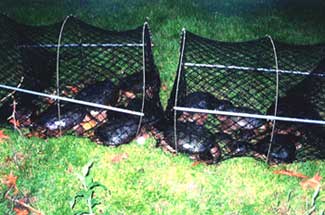
This fully collapsible turtle trap is made exclusively for WCS and is designed to handle the largest of turtles. The trap when set up measures 30"W x 25"H x 47"L. It has 3 D-Shaped hoops made of spring steel which forms the trap body, this trap won't roll when placed in the water. The hoops are zinik plated which makes them rust-resistant. The net mesh is 2.5" square and is very durable and will give years of service.

The trap comes complete with "spreader" rods to hold the trap in its' rigid set position. It also has a detachable bait bag which hangs in the rear of the trap for ease of setting. If you want to catch turtles and don't want to deal with a cage as large as a refrigerator, this trap is the ticket !


BAITING: This trap is very easy to bait. You take the removeable bait bag (included)out of the trap and fill it with small sun fish, suckers, chicken necks, a piece of beef liver, any type of bloody meat. Then tie the bait bag back into the interior center of the trap. The turtles will smell the bait and enter the trap through the large funnel opening. When using a large number of turtle traps it is handy to fill all your bait bags ahead of time and then place them in the freezer. When it is time to go catch turtles, simply remove your pre-loaded bait bags from the freezer and you are ready to go turtle trapping.

Sunday, June 07, 2009

CT Anti-Trap Legislation - A note from their Treasurer

The CT Legislation Session ended at midnight June 3rd without passing one Bill that would have impacted our right to trap in Connecticut!
 
 We won this battle due to all of your efforts, perseverance, and vigilance.
 
 Every letter, email, and phone call to your Representatives and Senators made a difference.
 
 We have many to thank, from organizations like the NTA and FTA that stayed in constant contact with us, organizations throughout the country who donated to our Legal Defense Fund, to the DEP with their Fiscal Impact documentation, to the CT NWCO organization, to our lobbyst, to Jeff Serena from the Examiner.Com ...
 
The CTA will thank them all officially.
 
 We have much more to do now, we cannot sit back on our laurels, we need to compile all of our "lessons learned", determine where we need to enhance our strategies, discuss opportunities to build upon our Legal Defense Fund and build upon our memberships attention to information by the best means possible.
 
 Once I can enjoy a few days of deep sighs knowing that this is over, I will be sending our new correspondence on upcoming activities that will need your continued support and involvement.
 
 May your boots stay dry and your plews be prime!
 
Regards,  Herb

Tuesday, June 02, 2009

Vacuums the Pros Use - The Omega GREEN Supreme IPM vacuum by Atrix

    • http://msg1svc.net/cnudu/179170/69/18952/12394/0/H/plgz.htmlhttp://msg1svc.net/cnudu/179170/69/18952/12394/0/H/plgz.htmlThe Omega GREEN Supreme IPM vacuum is made from high impact Starex flame retardant polymer for durability and long life. It comes complete with all accessories shown. It also features over-heat protection.
    • Filtration - HEPA FILTER (99.97% EFFICIENT @ 0.3 MICRON) A self contained HEPA filter cartridge reduces the risk of virus and bacteria dispersion. Most odors are contained. The cartridge filter makes filter changes easy, clean, and safe. Hose ends and filter can easily be sealed to ensure all debris is contained during transportation and storage.
    • Powerful and Quiet - Will capture everything from cockroaches and bed bugs to even hazardous particles.
    • Warranty - 3 year


Monday, June 01, 2009

Elephant farm causes lawmakers to ban(s)

Published: Sunday, May 31, 2009  Associated Press (bold ours)

HARTFORD — The Connecticut General Assembly won't take up a bill this session banning a long list of wild and potentially dangerous animals as pets.
The legislation stems from the February attack on a Stamford resident mauled by a 200-pound chimpanzee.

Rep. Richard Roy, co-chairman of the legislature's Environment Committee, said that the bill is being abandoned because some lawmakers want to protect a family-owned elephant farm in Goshen.

Many state politicians were outraged that potentially dangerous animals were allowed as pets after learning of the chimpanzee attack on Charla Nash, who lost her hands, nose, lips and eyelids in the assault. But Roy said Goshen-area lawmakers fought the bill.

"It's dead because there's a piece that was put into the bill that would have not allowed the Commerford family to bring in any new elephants in the years ahead, thereby, essentially closing the business down," he said. The farm has several elephants, a petting zoo and a variety of exotic animals, including zebras and camels. Commerford brings the animals to fairs and malls along the East Coast. "The Commerford Farm is a community fixture up in Goshen and it would be sad to see that business have to terminate what it does as it moves into the future," said Rep. Roberta Willis, D-Lakeville.

Even though the legislative session ends on Wednesday, Roy said it won't be brought up because the debate will take up too much time.

Sen. Andrew McDonald, D-Stamford, was surprised by the bill's demise. The legislation has been supported by the Attorney General and the Department of Environmental Protection. The DEP will be hosting an exotic animal amnesty day in July to persuade residents to turn in their illegal and legal exotic pets.

"The legislation is extraordinarily important and I understand that there were concerns expressed by some legislators, but there's certainly no excuse for not coming up with a reasonable compromise that would assure the safety of the people of our state," McDonald said.

Besides the Commerford dispute, the legislation also faced challenges from lawmakers who wanted to propose various amendments, such as grandfathering existing exotic animals to legalizing bow hunting on Sundays. http://www.nhregister.com/articles/2009/05/31/news/b8-animalban.txt
This bill H.B. No. 6552 (RAISED) ENVIRONMENT. AN ACT BANNING THE POSSESSION OF POTENTIALLY DANGEROUS ANIMALS AND THE IMPORTATION, POSSESSION AND LIBERATION OF WILD ANIMALS. Title changed from 'AN ACT BANNING THE SALE OR USE OF COMPUTER SOFTWARE OR SERVICES TO REMOTELY OPERATE WEAPONS TO HUNT ANIMALS OR BIRDS'. CCS opposed the "Computer Hunting" and supported the "Dangerous Animals" bill. Of the 14 amendments, the first two applied to the bill. When it was reported the Senate refused to debate S.B. No. 650 AN ACT CONCERNING THE CREATION OF A TRUST FOR THE CARE OF AN ANIMAL. which had S.B. No. 994 AN ACT CONCERNING LEGHOLD TRAPS attached as an amendment, after the bill failed in Judiciary Committee, the Leghold Trap Amendment was then proposed on the Dangerous Animals bill in the House. Both House and Senate Amendments were sponsored by the Chairmen of Environment Committee REP. ROY, 119th Dist. & SEN. MEYER, 12th Dist. The amendment on the Dangerous Animals bill, we felt, was a direct affront to DEP by placing an amendment which DEP opposed on a bill DEP wrote and supported. This amendment, we believe, effectively killed the "Dangerous Animals" bill when it was proposed. Pro-sportsmen legislators then responded by submitting amendments on Sunday Hunting. Then the anti-hunting frivolous amendments began (extracted from separate amendments): the arrow shall be labeled with the hunter's name and license number.; (a) (1) No person shall carry a pistol, revolver, machine gun, shotgun, rifle or other firearm, which is loaded and from which a shot may be discharged, upon his person (A) while under the influence of intoxicating liquor or any drug, or both, or (B) while the ratio of alcohol in the blood of such person is [ten-hundredths] three-hundredths of one per cent or more of alcohol, by weight. ;  (c) A person hunting on private property pursuant to subsection (b) of this section shall ensure that any arrow such person shoots from a bow with a draw weight of not less than forty pounds does not leave such private property.;  and A person hunting on private property pursuant to this subsection shall obtain the written consent of the owner of such private property, or of such owner's authorized agent and from the owners of all private property within a five-mile radius of the property such person intends to hunt on, or from such owners' authorized agents. – All submitted by REP. HORNISH, 62nd Dist. These same amendments with more co-sponsors are also proposed on H.B. No. 6553 AN ACT CONCERNING SUNDAY HUNTING.
The Senate bill was passed without the Trapping amendments, and we agree with Rep. Roy that the "Dangerous Animals" bill will not be addressed. The same can probably be said for the Sunday Hunting bill for the same reasons. However, we will continue to be watchful. Your communications helped tremendously to defeat this and other bills.
Remember, Nothing is ever Dead until the end of the session.
The session ends this Wednesday, June 3, at midnight.


--
Alan A. Huot, President
Wildlife Control Supplies

P.O. Box 538
East Granby, CT 06026
860-844-0101   860-413-9831 (FAX)

www.wildlifecontrolsupplies.com
"Products for Professionals"

Friday, May 15, 2009

ICWDM Newsletter

We are pleased to announce the next edition of the ICWDM Newsletter from the University of Nebraska is available for download at http://www.icwdm.org/Publications/icwdmnews.aspx


Wednesday, May 13, 2009

NEW CT ANTI-TRAPPING AMENDMENT

Unfortunately, it appears that we are a victim of our own success. Your phone calls and e-mails were so successful in blocking Senator Meyer from bringing out any amendments in the Senate that would impact the use of leghold traps that they have decided to try it in the House first. The leghold trap amendment has now been proposed on H.B. No. 6552 AN ACT BANNING THE POSSESSION OF POTENTIALLY DANGEROUS ANIMALS AND THE IMPORTATION, POSSESSION AND LIBERATION OF WILD ANIMALS. It had been speculated that they would try to attach it to this bill. It is the same as Sen. Meyer was going to use in the Senate comprising a ban and adopting bureaucratic Massachusetts type legislation. See the MA results at http://www.macrwm.org/inthepress.htm It is unclear when and if action will take place, so immediate action is necessary. Once again we’d ask you to take time out of your day to make calls today and tomorrow. Use the same message as used for the Senate: “I’m calling to oppose any ban on leghold and body gripping traps, could you be transfer to me to Representative ----------.” Call between 10:00am and 3:00pm. Contact the following legislators at the specific number listed. In addition AND contact your own Representative.


Speaker of the House Christopher Donovan

860 240 8500


House Majority Leader Denise Merrill

860 240 8500


Representative Richard Roy

860 240 8500


Representative Brian Hurlburt

860 240 8500


House Minority Leader Larry Cafero

860 240 8700  


You can find your CT legislator at http://www.cga.ct.gov/maps/townlist.asp  or in the Blue pages under “Connecticut, State of” then “Legislators”. Also, inform your friends who have an interest. Ask them to communicate.

While we urge you to use your own words, use the KISS principle, and please…do not be insulting or negative towards Any Senator, Representative, or anyone else in the Capitol.  Identify yourself and Town, State your position and why you Support or Oppose the bill. Be Brief, if they have questions they will ask.

Review all current bills and other info at the CCS website www.ctsportsmen.com


Monday, May 11, 2009

CT Trap Ban Amendments

Senator Meyer and Representative Roy has attached the original context of SB #994 and their proposed amendment to SB #650: AN ACT CONCERNING THE CREATION OF A TRUST FOR THE CARE OF AN ANIMAL.

http://www.cga.ct.gov/asp/cgabillstatus/cgabillstatus.asp?selBillType=Bill&bill_num=650&which_year=2009
We must again, contact our Legislators and oppose SB #650 with the
specific mention that the final Fiscal Note :
http://www.cga.ct.gov/2009/fna/2009SB-00650-R00LCO06716-FNA.htm
which has a price tag of close to $500,000 per year for the next two (2) years.


Tuesday, April 21, 2009

The cost of S.B. 994, Connecticut's proposed ban on leghold and Conibear traps

April 16, 11:16 PM
S.B. 994, An Act Concerning Leghold Traps, proposes to ban the use of leghold and Conibear traps in Connecticut. The original note on the fiscal impact of the law indicated that there would be minimal effect. The Office of Fiscal Analysis (OFA), however, has now corrected that initial assessment, based in part on an analysis of the experience of Massachusetts in struggling with its 1996 trapping ban.

The predicted cost to the state in lost revenues is estimated at $15,464 per year due to the loss of trapping licenses through the Department of Environmental Protection (DEP).

The estimated cost to the state in additional expenses associated with nuisance-animal management is $482,000 in fiscal years 2010 and 2011.

The estimated additional cost to Connecticut municipalities for nuisance-animal control is $92,000, as the services of volunteer trappers would no longer be available to Connecticut towns for the removal of problem beavers, and the towns would thus need to employ professional trapping companies.

The OFA cannot estimate other likely costs of the proposed trap ban: flooded basements, damaged roads, and contaminated drinking water due to flooding from beaver dams; increased damage to corn crops by raccoons; additional poultry losses to foxes and fishers; the loss of family pets to coyote predation. The list goes on and on.

Bad wildlife management is expensive. We might hope that the Humane Society of the United States, the key lobbyist for S.B. 994, will be willing to cover the costs if the law passes. But we all know that won’t happen. Connecticut taxpayers will get stuck with the bill.

http://www.examiner.com/x-4401-Connecticut-Nature-Examiner~y2009m4d16-The-cost-of-SB-994-Connecticuts-proposed-ban-on-leghold-and-Conibear-traps


Thursday, April 16, 2009

Conibear traps and S.B. 994, the proposed Connecticut trap ban


News article by Jeff Serena from the Examiner.Com

S.B. 994, An Act Concerning Leghold Traps, is making its way toward consideration in the General Assembly. It originated in the Environment Committee with the effective lobbying of the Humane Society of the United States (HSUS) in direct response to the highly publicized, ultimately fatal trapping of a great horned owl in January 2009. The trap in that incident was a leghold trap. Although the trap was illegal (unpadded, not offset, not anchored, anonymously set), and in such poor and rusted condition that it could not be made to work when tested later, it nonetheless provided sufficient ammunition for anti-trapping activists to set in motion a bill to ban leghold traps.
But a funny thing happened on the way to the General Assembly. By legislative sleight-of-hand, the Act Concerning Leghold Traps also includes language to ban Conibear traps. Conibears aren’t leghold traps. What are they doing in S.B. 994?
The Conibear trap is a killing trap. It’s known generically as a “body-gripping trap” among trappers and wildlife biologists, as a “body-crushing trap” among animal-rights activists, and as a “smooth wire trap” in the Connecticut trapping regulations. The Conibear trap is named for its inventor,
Frank Conibear. A well-known professional trapper and wilderness guide in Canada’s Northwest Territories, Conibear retired from the field in 1944 and began working on a design for a new trap that would kill a trapped animal quickly, rather than holding it alive until the trapper arrived to dispatch it.
By the mid 1950s, Conibear had his new trap. It’s a deceptively simple device that works much like a mousetrap. Two spring-loaded metal frames form an opening into which an animal is guided or lured. As the animal puts its head into the trap, it trips a trigger that snaps the frames together on the animal’s neck or upper body, killing it. Death generally occurs instantly due to a broken neck or dislocated spine, or very rapidly due to physical trauma and drowning. The Canadian Association for the Protection of Fur Bearing Animals provided financing for Conibear’s new device, which quickly gained popularity as an efficient and humane trap. In 1961, the
American Humane Association awarded Frank Conibear its Certificate of Merit for his invention.
In Connecticut, Conibear traps can only be
legally set in the water. They are, therefore, used exclusively for trapping aquatic furbearerslarge traps for beavers and river otters, and smaller traps for muskrats and minks. Although a trap set specifically for a beaver may occasionally catch a legal otter or muskrat, Conibears set in the water are extremely selective in excluding non-target animals, such as deer, birds, bobcats, and dogs.
Because they’re fast-killing and highly selective, Conibears pose a special challenge to anti-trapping activists. It’s easier to get a trap banned if you can plausibly argue that it causes a slow, agonizing death, or that it threatens pets or children or endangered species. As used by trappers in Connecticut, the Conibear trap plainly doesn’t do any of those things. And that’s why it’s in S.B. 994. There’s currently no practical way to get the Conibear trap banned on the merits, no matter how often you misinform people about it. But with public hackles up about the unfortunate owl, and a statewide ban on legholds a real possibility, you can slip the Conibear trap into the bill and reasonably hope that no one will notice. The trick may work, but it’s not a way to responsible or effective wildlife management.

Whidbey homeowners assess Mudslide Damages caused by Beaver Dam Failure

WHIDBEY ISLAND, Wash. – South Whidbey Island residents are cleaning up and assessing damages today after mudslides swamped their waterfront homes.
 
See video clip of the mudslide:
 

Monday, April 13, 2009

Connecticut Trapping Important to Coyote Removal

Trapping appears to be more important in the harvest of coyotes following the regulation change that allowed limited land trapping.  In the 5 seasons preceding this regulation change an average of 37 percent of the coyote harvested were trapped and 54 percent shot.  In the three seasons since the regulation change an average of 59 percent of the coyote harvest was from trapping and 32 percent was from hunting.


Monday, April 06, 2009

Fonfara Withdraws His Sponsorship of S.B. 994

Fonfara took his name off the sponsors list of SB 994. His office said he changed his mind!!!!

Way to go 1st district trappers!! Keep up the good work!

A short msg. of thanks to Mr. Fonfara is in order too!

Monday, March 30, 2009

Beta testing S.B. 994, Connecticut's proposed fur trapping ban

S.B. 994, Connecticut's proposed fur trapping ban
<

March 23, 1:47 PM
S.B. 994, "An Act Concerning Leghold Traps,"
<> has been
approved by a vote of 22-8 in the Connecticut General Assembly's Environment Committee, and will now be considered by the legislature. If enacted, the law will largely ban the use of leghold and Conibear traps in the state.Proponents of the measure argue that passage of S.B. 994 will finally end an unacceptably cruel practice. Opponents argue that trapping is not inhumane,and that it is an important tool for wildlife management in Connecticut.In 1996, voters in Massachusetts approved an anti-trapping ballot referendum expertly pushed by animal-rights organizations. Formally titled the Wildlife Protection Act, the law is more popularly known as Question One. Like S.B.994, Question One bans the use of leghold and Conibear traps. The Massachusetts experience, particularly with regard to management of the state's beaver population, is a useful case study for understanding the practical implications of S.B. 994.Prior to Question One, Massachusetts had a healthy beaver population estimated at approximately 23,000 animals. Homeowners and others dealing with occasional beaver problems, such as the destruction of trees and the flooding of yards and basements, could call MassWildlife <http://www.mass.gov/dfwele/dfw/> , the Massachusetts agency that is roughly the equivalent of the Wildlife Division of Connecticut's Department of Environmental Protection (DEP). MassWildlife would typically refer the caller to the Massachusetts Trappers Association. The MTA would recommend a trapper, who would come out during the trapping season, generally at no cost to the landowner, and kill the beaver.As in Connecticut, most Massachusetts beaver trapping was done with Conibear traps set in the water. Conibears are not leghold traps. They are lethal traps that work on much the same principle as the familiar mousetrap. A beaver is guided or baited into putting its head into the trap, triggering stiff wire arms that snap down on the animal's neck, dislocating the
beaver's spine and killing it.Question One banned Conibears but not "humane" box traps and suitcase traps.In Massachusetts, these traps are used to capture beavers alive and unharmed so that they can be killed later. Relocating beavers is illegal in Massachusetts. Box traps and suitcase traps make trapping, which is demanding work in the best of circumstances, even more difficult. They're
bulky, heavy, and time consuming to carry and set. They're also expensive,and with the market for furs so depressed, it's hard for a trapper to
justify replacing his Conibears with cage traps that may well cost more
money than a successful trapper will realize from the furs he takes in a
whole season's trapping.
The ban on Conibear traps very nearly ended fur trapping for beavers in
Massachusetts. In the last trapping season before the ban took effect,
trappers harvested 1,136 beavers in the state. By the 1997-98 season, the
number of beavers killed by trappers had dropped to ninety-eight.
Animal-rights organizations hailed the passage of Question One as a signal
victory for their cause. Then things began to get complicated.
Suddenly relieved of the pressure of its main predator, the beaver
population in Massachusetts grew explosively. By 2000, the population was
estimated to have tripled to about 70,000 animals. As the beaver population
increased, reports of damaged private property, blocked culverts, and
flooded roads due to beaver activity skyrocketed. Public water supplies in
towns like Sterling
<http://www.wwdmag.com/River-Contaminates-Town's-Water-Supply-When-State-Lea
ves-It-to-Beavers-article3199
> and Chelmsford
<http://www.fishwildlife.org/furbearer_cases.html> were contaminated by
flooding caused or exacerbated by beavers.
Massachusetts had long had some problem beavers, but beavers were now a
widespread problem. As environmentalist firebrand Ted Williams wrote
<http://list.audubon.org/wa.exe?A2=ind0501&L=audubon-pa&P=77> in Audubon
magazine, "We've converted a resource to a pest."
The 1996 passage of Question One, which banned the use of leghold and
Conibear traps in Massachusetts, led to a dramatic increase in the state's
beaver population. By 2000, beavers had become serious pests, and their
activities were flooding highways, contaminating drinking water, and causing
extensive damage to private property.
In 2000, the Massachusetts legislature responded by modifying Question One
to allow local boards of health to issue emergency permits for the use of
Conibear traps, not just during trapping season but at any time of year, to
destroy beavers that pose a threat to human health and safety. This action
completed a fundamental shift in beaver management that had begun with
Question One four years earlier. Instead of actively managing the beaver
population strategically and across the state, Massachusetts now manages
beavers reactively through local damage control in an endless series of
small crises. With much of the state's beaver control now in the hands of
town health boards with no reporting requirements back to the state,
MassWildlife, the agency ostensibly responsible for wildlife management in
Massachusetts, can no longer even accurately estimate the size of the
state's beaver population.
Massachusetts homeowners once had their beaver problems resolved largely by
recreational fur trappers-at no cost. Now many homeowners pay nuisance
animal control operators hundreds of dollars, and sometimes more, for
trapping, fencing, tree wrapping, and the installation of flow-control
devices in beaver ponds. Massachusetts taxpayers have also taken a financial
hit, as highway departments and towns pay for beaver-control services.
Additional concerns about the growing beaver population have arisen,
including an increase in mosquito breeding habitat and a possible link to
mosquito-borne diseases like West Nile Virus.
And what about the beavers? Because of the large number of problem beavers
now being trapped for damage control, it's estimated that the number of
beavers being killed annually by trapping in Massachusetts (based on 2006
data, which are the most recent available) is higher than the number killed
before Question One.
When good technology managers consider purchasing a new hardware or software
product for their company, they make certain that the product has been
subjected to adequate beta testing to ensure that it will work in their
operating environment. As the General Assembly considers S.B. 994
<http://www.cga.ct.gov/2009/TOB/S/2009SB-00994-R00-SB.htm> , it needs to
look at Question One. Massachusetts has, in effect, done the beta testing
for Connecticut's proposed trap ban. The results couldn't be clearer. It
doesn't work.
When I began looking into the issues surrounding S.B. 994, I was about as
neutral as a person can be on an extraordinarily polarizing subject. Since
then, I've spent many hours reading about trapping: scientific papers, news
stories, blogs, and a lot of anti-trapping literature. I've spoken and
corresponded with trappers, wildlife biologists, and animal-rights
advocates. I've been privileged to meet thoughtful, gracious, helpful folks
on all sides of the debate. And I'm not neutral anymore. S.B. 994 is
flat-out bad legislation.
The people who are providing the main impetus for S.B. 994 surely have good
intentions. The Humane Society of the United States <http://www.hsus.org/>
(HSUS) is the key lobbyist for the trap ban. HSUS is a smart organization
that does much good work on behalf of animals. No one should confuse them
with groups on the lunatic fringe <http://www.petakillsanimals.com/> of the
animal-rights movement. Even folks who vehemently disagree with HSUS on
policy matters should still recognize that the organization's local staff
and volunteers are sensible people who genuinely care about Connecticut and
its wildlife.
Senator Ed Meyer <http://www.senatedems.ct.gov/Meyer.html> led the charge
for S.B. 994 in the Environment Committee, and seems likely to perform the
same role in the General Assembly. Senator Meyer represents the 12th Senate
District <http://www.cga.ct.gov/red/2001senate.htm> , where I happen to
live. He's a good man-an effective legislator who works hard on behalf of
his constituents and the people of Connecticut. I've voted for him twice,
and I hope to do so again. But even good legislators and smart organizations
sometimes make mistakes. S.B. 994 is a mistake. It will be best to tell them
so.
http://www.examiner.com:80/x-4401-Connecticut-Nature-Examiner~y2009m3d23-Bet
a-testing-SB-994-Connecticuts-proposed-fur-trapping-ban-Part-1

Support Your fellow sportsmen:
"We must, indeed, all hang together or, most assuredly, we shall all hang
separately".
Benjamin Franklin
<http://www.brainyquote.com/quotes/quotes/b/benjaminfr151597.html>
http://www.brainyquote.com/quotes/quotes/b/benjaminfr151597.html

Friday, March 27, 2009

Collarum Testimonial


Just sending a quick note to say this trap works great. I have captured some hard to catch dogs with it that I do not think I would have captured otherwise. Your support has also been excellent. I e-mailed you several months ago in reference to a hard to catch dog. You sent another bite piece and additional instruction, which helped. While the Collarum did not catch that dog (she was eventually captured when she had puppies), it has caught other dogs that would have taken considerable time to capture. So, thank you for an outstanding product. I just wish we would have had it when trying to get those dogs which took us years to apprehend!
 
Deputy S.M. Jessee
Caroline County Sheriff's Office
Division of Animal Control
14080 Devils Three Jump Rd.
Milford, VA 22514
Office: (804) 633-9041 Fax: (804) 633-2084

--

Thursday, March 26, 2009

STATE LEGISLATORS DON’T GIVE A DAM ABOUT THE CT RIVER VALLEY


Ban on Trapping Threatens Integrity of Connecticut River Flood Protection Dikes
 
West Hartford, CT. (March 26, 2009) – State Legislators may soon be voting on a controversial measure to ban certain kinds of traps in Connecticut, including traps currently used by wildlife professionals to control burrowing animals in the Connecticut River levee system. The Connecticut Nuisance Wildlife Control Operators Association, Inc. (CTNWCO Assoc., Inc.) expressed alarm at this proposal, citing millions of dollars in repairs to the levee system attributed to wildlife problems over the past several years. The same Legislators considering this ban have already allocated millions of taxpayer dollars to protect the safety and property of residents in the areas of these  levees. "We are deeply concerned about the state's ability to continue to keep the population levels of these animals in check without these vital tools," said Tom Logan, Vice President and spokesman for the CTNWCO Association. The General Assembly's Environment Committee recently approved a bill co-sponsored by Hartford state Senator John Fonfara and Plainville Representative Elizabeth "Betty" Boukus to ban foothold and Conibear traps in the state.
 
According to Nick Casparino, a Civil Engineer for the town of East Hartford, the town last year alone paid a private contractor $4 million to repair nearly four miles of town-owned dikes that protect it from the Connecticut River. The town has allocated $25 million to rehabilitating the dike system. Casparino said that more than $58,000 has been paid to the contractor so far for controlling and repairing wildlife damage to the dike system, but the project is still ongoing. Mr. Casparino said that the US Army Corps of Engineers is requiring an ongoing program to control wildlife and remediate the damage caused by wildlife, which is very extensive since they must bring in heavy equipment every time an animal burrows into the earthen dike.
 
According to a 2005 report on the state's dams, "Dam Safety in Connecticut", compiled by the Connecticut Department of Environmental Protection's Bureau of Water Management, Connecticut had 22 deficient dams in 2004. The US Army Corps of Engineers' 2007 report on National Inventory of Dams indicated that there are 468 earthen dams in Connecticut, representing 64% of the 723 dams in the state. This report also indicated that 62% of the dams are privately owned, and 18% are owned by local governments. Wesley Marsh of the bureau of Water Management stated, "It will be hard to tell a private levee owner that they need to remedy a wildlife issue, then have the wildlife department tell them that they cannot trap the animal. Especially if they had a trapper previously managing the beaver population for no charge."
 
According to USA Today's December 22, 2008 article, "Most Levee Repairs Lagging", the US Army Corps of Engineers indicated that the worst offenders are Washington and California, where levees with "unacceptable maintenance deficiencies" protect densely populated cities like Seattle and Sacramento. While Connecticut has recently provided $5 million to improve Hartford's levees, no one knows how this trapping ban will affect the cost of repairing the levees in the future. One has to wonder if it will even be feasible to perform the repairs without being able to use the proper tools, such as traps, to control the burrowing animals causing the damage. If the repairs are delayed, the US Army Corps of Engineers could bar access to recovery funds, should there be a catastrophe. Tom Logan, Vice President of the Connecticut Nuisance Wildlife Control Operators Association, Inc., states, "The state lawmakers need to look at the overall picture of this ban on trapping, and look at where these tools can be used effectively to manage wildlife to protect human interests. How will a muskrat or beaver that is burrowing into a levee be caught without these tools being available anymore? It's ironic that the two states that are the worst offenders are states that ban these traps."
 
According to Dan Marks, a civil engineer and a consultant of the Association of State Dam Safety Officials, burrowing animals like muskrats and beavers are the two most common wildlife species to cause structural damage. Muskrats burrow into the levees and weaken their integrity. Beavers obstruct spillways, burrow into the levee, and move mud and material to create their own dams. Mr. Marks says that water level devices are not a good option since they are expensive to install and maintain. He stated that last year in June a muskrat had undermined a repaired water-saturated levee that was holding back the relentless Mississippi River in eastern Missouri. The town residents had worked for several days to maintain the levee from the rising waters. This only affected about 100 homes, but the levee was protecting an area of about 3,000 acres, and the damage happened when everyone was sleeping.
 
Muskrats and beaver aren't the only wildlife causing damage to dikes.
 
"How can we control moles that are eroding the surface of these levees?" asked Richard Daniotti, owner of Wildlife Control Services of West Hartford. "These lawmakers are supposed to look out for the environment and the people. Yet if they ban the use of traps, they will only cause more poisons to be absorbed into the environment, including our waterways." Daniotti also pointed to the FEMA (Federal Emergency Management Agency) technical manual for wildlife control professionals to use in managing these animals, "FEMA highly recommends these same traps that the state lawmakers are trying to ban."
 
The Connecticut Department of Environmental Protection's Deputy Commissioner, Susan Frechette, testified at the environmental lawmakers hearing on March 9th in opposition to the trap ban, citing a detrimental impact on wildlife management. She testified that if the traps are banned under the proposed legislation, the most effective, and for some species, the only effective tool, will no longer be available to wildlife control professionals. Senator Edward Meyer of Guilford responded to Deputy Commissioner during the hearing by saying, "I am appalled that the department is condoning the use of these traps"
 
The Connecticut Nuisance Wildlife Control Operators Association is a non-profit organization to promote general standards and ethics as well as foster education, research, and knowledge within the nuisance wildlife control industry.
 
###
 
For more information on this topic or to schedule an interview with Tom Logan, please call 203-375-1211 or email Wildthingsllc@att.net
or
Richard Daniotti at 860-236-2683
 
Or visit our website www.ctnwcoa.com

--
Alan A. Huot, President
Wildlife Control Supplies

P.O. Box 538
East Granby, CT 06026
860-844-0101   860-413-9831 (FAX)

www.wildlifecontrolsupplies.com
"Products for Professionals"

Monday, November 24, 2008

Nomol Trap Setting

See a brief video clip of "How to Set the NoMol Trap" from the complete production
MOLES: Removal made Simple. Just posted on YouTube:

http://uk.youtube.com/watch?v=MZE6qoEA73A

Thursday, October 30, 2008

Thursday, October 16, 2008

The Collarum

Short video clip of the Collarum "In Action" at the National Wildlife Research Center in Denver

Wednesday, October 08, 2008

Camporee 2008

Wow, Fantastic, Tremendous........a helluva lot of fun, those are just some of the words I'll use to describe the recent 1st Annual Camporee coordinted by none other than Kirk Lapierre. As with anything Kirk puts his mind to he pours his heart and soul into his endeavors and it sure came through at this event. The weather helped of course as it was an absolutely perfect early October day, but the food was out of this world, basically eat 'til you drop, there were scheduled demonstrations going on throughout the day, and of course the swap meet or tag sale tables. You could tell that people really enjoyed the day.

Unfortunately, I didn't get to attend the entire event as I had other commitments for the early part of the weekend, but Sunday was everything I described above. I picked up Jim Dreisacker (BatCone) on the way down and the State campground was very easy to find, it is almost parallel to the Hudson River. The grounds are wonderfully kept, it had a nice outdoor pavilion and I'm told the lodge where folks could sleep was very nice as well.

I for one am hoping Kirk has enough energy to pull the Camporee together for next year, this is certainly an event well worth supporting and for those that decided not to attend they really missed a worthwhile event. Kirk, please sign me up for next year !!

Monday, September 22, 2008

Critter Control Opens CT office


WCS had the pleasure of a visit by one of Critter Control's newest managers, Ray "Doug" Humphrey. Ray is the new manager of the Central Connecticut area office.
He comes to Critter Control with 28 years experience in a suburban police dept., and Doug has dealt with and resolved many conflicts between wildlife and people. WCS recently received an announcement from Critter Control's CEO, Kevin Clark, notifying the wildlife industry of their new office and introducing Doug. Doug brings with him a variety of skills, including his extensive investigative knowledge which will serve him well as a Critter Control representative.

WCS welcomes Doug Humphrey to the wildlife control industry !

Friday, September 05, 2008

NPMA 1st Nuisance Bird & Wildlife Conference - Nov. '08

The National Pest Management Association's First Ever Nuisance Bird and Wildlife Management Conference & Marketplace!


Educational Program & Registration is Live!

The National Pest Management Association (NPMA) is excited to offer its first ever Nuisance Bird and Wildlife Management Conference and Marketplace, November 19-21, 2008 at the Westin St. Louis in St. Louis, Missouri. The schedule of events and educational program including speakers is now online.


Click here to register.

Click here to view the conference program.


What It's All About?

This first rate educational program is divided into two tracks – an introductory track aimed at newcomers to nuisance bird and wildlife management and an advanced track geared toward veterans of this sector. From regulatory requirements, business models and public perception to mole control, bat management and bird control – both tracks provide valuable business and technical information for your level of service.


Who Should Attend?

Anyone who currently provides pest and nuisance wildlife management services, is just entering the market, or considering expanding their service offerings to this sector – this conference is for you!


Click here to register.


Take Advantage of the Marketplace!

A centerpiece of the conference is the Marketplace, which will connect pest and wildlife management professionals from around the country with suppliers of products and services related to this sector. During the conference, attendees will explore new business opportunities in the nuisance wildlife arena for the pest management professional.


Interested in Exhibiting at the Marketplace?

Space is filling up fast! Click here for more information or contact Alexis Wirtz at awirtz@pestworld.org or call 703-352-6762.

Thank You to Our Co-Sponsors!

Critter Control

National Wildlife Control Operators Association (NWCOA)
Wildlife Control Supplies

Wednesday, December 26, 2007

WCS joins YouTube


WCS has uploaded the first of many instructional videos to come to YouTube. YouTube with its' huge presence in cyberspace is an excellent medium for communicating short instructions on such things as using equipment, methods, techniques, new products, etc.

There are certain products which people find particularly confusing and those will be our initial focus. The first instructional video covers the proper and safe setting of the Belisle Footsnare. We have found the manufacturer supplied printed directions less than adequate for explaining the setting of this device.......so this is our "trial balloon" if you will. If there is a particular device or technique you'd like to see us include, please feel free to send us a note, we'll place it on our list.

So let me invite you to our Channel on YouTube, feel free to subscribe and be notified when new videos are uploaded. Click below:

www.youtube.com/shopwcs

Wednesday, November 07, 2007

Weep Holes for Rodent Prevention


As we enter the fall season many pests will gain access to commercial and residential accounts via weep holes in the buildings of these accounts. Weep holes are either the gaps left between some bricks in external walls or the small openings in window framing. Weep holes serve two important purposes: 1) Ventilation of the internal wall cavity - without ventilation, mildew, dry rot and damp reduce the life of the internal wall studs and other building materials within the cavity, and 2) Drainage - water that enters the cavity due to capillary action, condensation, damage, or accidental flooding needs to escape somewhere.

Though necessary, unfortunately, weep holes also present a problem in that they also provide access to the wall cavity for rodents and insects, especially as temperatures cool down and pests seek harborage for warmth. Swarming bees and European wasps also love cavities. Field mice make a track through the weep holes looking for nest sites. Snakes, cockroaches and spiders find refuge in the cavity.

In desperation, many homeowners and commercial building occupants will resort to blocking weep holes with any number of materials such as silicon sealants, rolled up paper, plastic, scourer pads or steel wool to keep the pests out. These so-called solutions obstruct airflow to the cavity and set up moisture problems down the road. This can be very costly to fix later. The better way is to use small mesh screening inserts or weep hole inserts that can be purchased from your distributors or construction product distributors. These will keep the pests from entering in the first place. Applying a repellent residual first can also be useful for insect pests.

When thinking about pests that enter the weep holes, keep this rule of thumb in mind.1/2, ¼ and 1/16. Rats require a space only ½ of an inch wide to enter a building. Mice require a space of only ¼ of an inch wide to enter a building. And, most insect pests require only 1/16 of an inch wide space to enter a building. Weep holes come in various sizes, but can allow for most any of these pests. Excluding them with inserts or screening that allows the weep hole to still function as it should, while preventing the pests from entering is what is needed to properly keep pests out.