Saturday, June 10, 2006

Snakeguard Snake Traps

There are basically two commercially available snake traps on the market today. They both operate on the same principle, that is to place the snake trap in such a manner as to force the snake to enter the snake trap, whereby it is captured on a glue strip or glueboard. A snake when encountering the glue surface inside the confines of a trap cannot merely turn its' head and leave the trap without being captured. A snake must draw its' entire body into the trap, in an attempt to reverse direction and thereby is captured in the glue along its' entire bodylength.

The formulation of glue used in both of the snake traps is such that it can be neutralized if the desire is to capture a snake and then relocate it. Neutralization of the glue is accomplished by pouring regular vegetable oil (or spraying a vegetable oil such as PAM) on the captured snake along its' entire length. It typically will take from between a half and a full cup of vegetable oil to release a snake unharmed. This process will take several minutes, so you need to be patient.

The Snakeguard Snake Trap which was the first to hit the commercial market has enjoyed widespread acceptance among professional operators and homeowners for capturing and removing snakes. This snake trap, constructed of corrugated cardboard has a glue "pattern" built into the inside of the trap. The glue pattern is in the shape of a "V", where the point of the "V" touches the extreme outside edge of the snake trap on its' inside. This requires that the snake fully enter the snake trap before its' head initially encounters the glue. When the snake attempts to leave by drawing its' body in behind itself its' body is "stuck" to the outwardly positioned legs of the "V" glue pattern. The Snakeguard snake trap is an excellent tool for indoor applications such as a sunroom, porch, garage, basement area, etc. Due to its' construction material it is not so well suited for outdoor areas.
snakeguard snake trap
Setting the Snakeguard Snake Trap: The Snakeguard snake traps initially come completely flat for ease of shipping. Remove the outer plastic covering that it comes shipped in and open the snake trap at its' midpoint to expose the "V" pattern of glue which has two protective strips covering it. While holding the box open, firmly grasp one end of one of the protective strips and peel off, exposing the underlying glue. Do the same for the remaining side. While continuing to hold the box open, bend the corrugated cardboard along the pre-defined lines, such that it forms a rectangular box. There are two tabs located on one side of the outside edge of the rectangle. These are placed through their corresponding slots in the roof of the snake trap so the box holds its' shape. You should now have a rectangular box with the Snakeguard logo on top, with the glue exposed on the inside. The only thing left to do is to place the snake trap along a wall, foundation or similar which will guide the snake into the trap. It sometimes helps to place a piece of duct-tape from the inside edge of the snake trap to the wall it is placed against so the snake cannot attempt to "squeeze" between the box and the wall without entering the trap.

The Snakeguard snake trap is able to capture some of the largest nuisance snakes as we have personally seen it capture black snakes in the 5.5 ft. range. These traps are available at
www.wildlifecontrolsupplies.com

Friday, May 05, 2006

Bat Cone improves bat exclusions


The BATCONE is a new time-saving bat exclusion device, invented by Jim Dreisacher who owns and operates Westchester Wildlife. The BAT CONE basically is a humane, one-way door for bats to leave the structure and NOT return.

The BATCONE is currently produced in two models; 1. the Standard Bat Cone, which is one-piece and is made of lightweight, yet durable plastic. As the name implies it is a cone or tapered funnel 5.75 inches long, with a 1.5 inch opening at the end. At the opposite end, or the end you would attach to the structure there is a rigid plastic flange which is 6 inches by 6 inches. As with both of the Bat Cone models the flange can be cut or bent to the angle of the structure for anchoring. The bat cone can be anchored using deck screws (wood) , stapled or even taped over a bats entry/exit point. The optimal position of the BAT CONE once it is installed is for it to have a slight downward slope. Bats cannot grip the inside of the bat cone, once they exit through the cone, they cannot re-enter.

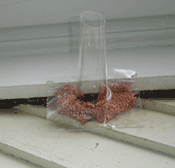
As you can see in the photo, it is sometimes necessary to add some copper mesh underneath the BAT CONE to take up the space between the bat cone and the structure. The only opening you want for the bats to exit is through the BATCONE. To limit the exit point for the bats you may also need to apply a closed cell foam such as Todal foam, or caulk on each side of the opening.

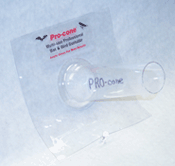
2. Pro-Cone is the latest bat cone model that has been developed. The ProCone is a two-piece bat cone, with the flexible vinyl flange being separate from the tapered plastic cone. The ProCone measures approximately 6" in length with a 1.5" opening on one end. The vinyl flange measures 7 inches by 7 inches, making it versatile for mounting to structures, including dissimilar surfaces, i.e. stone chimney up against clapboard siding. While both models of bat cone are reusable , the ProCone lends itself especially well being to being reusable as the vinyl flange material can be purchased separately.

Pro-Cone can be screwed, stapled or taped into position over a bats entry/exit point. With the optimal positioning being a slight downward slope to the tapered cone.

Once a BATCONE is mounted over a bats entry/exit point in a structure it should be left in place a reasonable amount of time to allow the bats to exit the structure. This time period will vary, however 5 - 7 days is typically sufficient according to Bat Conservation International. Leaving a bat cone in place for longer periods is not detrimental. Please Note: It may be necessary to use more than one Bat Cone to exclude bats from a structure. All entry/exit points on a structure must be identified and a bat cone installed to successfully exclude the bats. Failure to follow this procedure may result in merely moving the bats to another part of the building.

Once it has been determined that the bats have been successfully excluded from a structure it is then necessary to remove each of the installed bat cones and permanently seal the exit point openings using hardware cloth or copper mesh inseted into the hole and then completely sealed with closed cell foam or a quality silicone caulking.

The BATCONE or Pro-Cone are both time-saving devices for excluding bats from structures and eliminate the need to fabricate something onsite. The bat cone looks professional when mounted and will leave your customer with an impression of confidence in your ability to solve their bat problem.

Saturday, March 04, 2006

Vanish Raccoon Eviction Paste


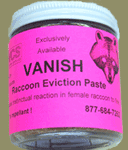
VANISH raccoon eviction paste causes a biological instinctual reaction in female raccoon to flee an area where she is denning, many times taking her young with her. VANISH is a naturally occurring glandular based product, and it is no more a repellent (nor should it be classed as such) than coyote urine to a coyote !

VANISH has the consistency of a thick paste, making it easier to handle and apply than a liquid. It is especially well suited for evicting denning raccoons from inaccessible areas such as attic recesses, or down chimneys. Simply apply a "smear" of VANISH (approach. 1/2 oz.) to a rag or to a tennis ball and toss as close to the area where she is denning as possible. In the case of a chimney, it is a simple matter to just drop the VANISH laden tennis ball down the flue where the raccoon is dwelling. The ball can then be retrieved for disposal or re-use through the opened damper, once the raccoon and her young have vacated. Place the ball or rag in a plastic ziplock bag and tightly seal it to maintain its' freshness.

If there is a distinct entry/exit hole on the outside of a structure which the raccoon is using for access to an attic area, smear some VANISH on the upper lip of the hole so that the female may get some on her back fur while crawling through the hole. This will add to the effectiveness of the VANISH application.

While no claim is made that VANISH is 100% effective at evicting denning raccoons, since its' introduction to the marketplace in 2003 it has proven 95+ % successful. Remember, you're still dealing with a wild animal and its' reaction to VANISH depends on the individual characteristics of each animal encountered.

PLEASE NOTE: To place or apply VANISH where it will have the greatest chance of success many times involves working on ladders, rooftops, over or under chimney flues, and in confined spaces, i.e. attics. If you are uncomfortable or unsure of yourself in these unsafe situations you should considering hiring a professional wildlife control operator.

Sunday, February 26, 2006

NY Wildlife Mgmt. Assoc. Show

Carol & I are just back from the NYWDMA seminar held in Owego, NY and I have to tell you we had a wonderful time !! This is perhaps the 5th NY show we've attended and I've got to tell you these guys work hard all year long to put on a quality seminar. This year was a couple of "firsts" for them.

1. They changed locations this year, for the past several years it had been held up at Carrier Circle near Syracuse. This year, in an attempt to attract some more "downstate" folks they moved the venue to Owego, NY, which is about 10 miles west of Binghamton. The location was right on the Susquehanna River, held at a Treadway Inn, the accomodations and hospitality were wonderful.
2. They changed their seminar format to a 2 day conference and were able to offer to full days of course instruction, after-hours roundtable, and plenty of time for the attendees to visit the vendor displays.

The NYWDMA is run by top-notch professionals and they work hard to put on a high quality conference. If you haven't had the chance to attend this show in the past you should give it serious consideration for the future. The information exchanged both formally and informally after-hours is most certainly going to improved even the most seasoned professionals business.

Carol & I are hoping they hold the '07 conference in Owego, great location & accomodations, lots of great people, and a quality course offering are certain to attract a great crowd !! Hope to see you there !!

Sunday, January 22, 2006

Skype

Skype has been around for awhile, I even downloaded it sometime ago but never really explored its' features or the convenience of it. Recently, I received a new invitation to join the Skype community and I have to tell you it is one of those "killer applications" you should have on your PC.

In a nutshell, Skype is a voice application which I can liken to instant messaging. People who are in your contacts list can see when your on your computer, you see them, and you can talk over the internet. O.K., heres the best part..........it's FREE !! Anywhere in the world. The sound quality is wonderful, and you basically can hold a hands-free conversation, even while doing other things. If you're one of those folks that has a webcam, you can even turn on the cam and see each other while talking.

Now think of it, how much time do you spend in front of your computer ? I know I spend an "inordinate" amount of time in front of the tube and this is a great way of staying in touch with folks.

Now I know some of you are saying "Yeah,but I don want to be bother with a voice call" while on
my computer. No problem......you can just set yourself as unavailable. For those of you that don't like to type, Skype is the answer, now you can talk to your circle of friends and associates.

WCS is using Skype, and you should consider taking advantage of it too !!

Thursday, December 15, 2005

More News on the NJ Bear Hunt

Two Predators Engaged In Timeless Ritual
December 15, 2005
Cry me a river. That's what I say to the animal rights activists protesting blood on the snow in northwestern New Jersey, where nearly 300 black bears were killed during a six-day season ending last weekend. A shot of adrenaline. That's what I say to the 7 percent of the 4,400 hunters who actually bagged one. It must be quite a rush to kill a huge bear, though it's not my idea of fun. Wildlife management. That's what the New Jersey Department of Environmental Protection was doing. They sponsored this legal blood-letting to help thin the burgeoning population of Ursus americanus expanding into this part of America's eastern megalopolis. Black bears are basically omnivores. They are fun to watch from a distance, being curious, ingenious, agile and fuzzy. But there's no humor in having them scare your children or destroy your campsite, bird feeder, garden shed, dumpster - you name it - just to find food. They have an undeserved reputation for aggression, but attacks do happen. And with weights commonly in the 400- to 600-pound range and four long legs, they are strong enough to tear down a patio deck and fast enough to run more than 30 miles per hour. Black bears are not always gentle and retiring. They pestered our field camps in Alaska for years. (I worked there in the early 1970s on archaeological projects.) Though I never had to kill one, my colleagues did. On several occasions, I had to fire noise-making shots with the .44-caliber magnum I kept beside my pillow. Though we were mostly worried about grizzlies, black bears were a chronic threat to our food and to a lesser extent our safety, forcing us to: lug firearms around during the day (a short-barreled, 12-gauge, pump-action shotgun was the recommended weapon); build expensive caches high in the trees; hike with the constant noise of bells on backpacks; and wait patiently for them to move on before we could get back to work. I still get scared when I remember the smell of bear halitosis in my tent at night and the mauling of a colleague who had both her arms chewed off by a black bear shortly after we played Frisbee together.Animal rights activists are absolutely right that we must be compassionate to other creatures. Certainly there is a more expensive but more humane way to kill a surplus population of bears, such as tranquilizing them into teddy bear dreams by shooting them with hypodermic darts from helicopters. Hunters are absolutely right that their sport satisfies something deep in the human psyche. Stone cut-marks on bone are among the earliest clues to hominid behavior. Kill and butchering sites are common archaeological excavations.The Inuit (Eskimos) of the 19th century had no choice but to kill seals that have since become favorite stuffed toys for animal activists. The New Jersey hunters do have a choice whether to hunt or not, thanks to the invention of grain feedlots, slaughterhouses and fast-food joints en route to their hunting grounds. But they do not have a choice to set aside millions of years' worth of instinct that evolved to help ensure our survival. Hunting is so much more than obtaining free-range meat or satiating a blood lust. The ice age cave paintings portray it as a religion. For modern men, it's the ultimate in male bonding, better than football.One inviolate rule of evolution is that there must be an excess population from which the most fit will be selected. The excess population of bears in New Jersey has just been selected upon by human predators. After the hunt, and due to some combination of blind luck, activity schedule, habitat preference, wariness or coloration, those bears left remaining in the woods of New Jersey are probably the ones more likely to stay out of suburban trouble. I'm not a PETA member, though I am a person for the ethical treatment of animals. But I do know two things. Homo sapiens is an animal that hunts. And hunting can help keep the world in balance.Robert M. Thorson is a professor of geology at the University of Connecticut and a member of The Courant's Place board of contributors. His column appears every Thursday. He can be reached at profthorson@hotmail.com. http://www.courant.com/news/opinion/op_ed/hc-thorson1215.artdec15,0,4779830.column

Sunday, December 11, 2005

Slow Start to Deer Season !

A Slow Start for Deer Hunting: A Slow Start to the Deer Hunting Season

By DAVID BRENSILVER Published on 12/9/2005
Lyme - This season's warm weather apparently has reduced the number of deer killed by hunters, compared to last year, state wildlife experts report.
According to Department of Environmental Protection wildlife technician Andrew Labonte, hunters killed 5,825 deer the first two weeks of the hunting season, which began Nov. 16, about 400 fewer they killed during the same period last year.
Labonte said unseasonably mild conditions likely contributed to the decline.
Ron Rando, whose East Lyme store, Ron's Guns, is an official station for hunters to register their kills, agreed.
“Warm weather, I think, has a lot to do with it,” he said.
Both Labonte and Rando said deer don't move around as much during warm weather, making it more difficult for hunters to see and shoot them.
The reduced kill comes at a time when the state is encouraging hunters to take more deer in shoreline regions.
The DEP has allowed the use of bait since 2002 in shoreline zones, and replacement tags are given to hunters who have killed female deer. That means that a hunter can harvest a limitless number of female deer. Does produce two fawns per year, on average, Howard Kilpatrick, a wildlife biologist with the DEP, said.
This year, he said, the DEP is giving hunters a free replacement tag for every three antlerless deer checked in, plus a bonus buck tag.
Hunters using rifles receive permits to kill one buck and one doe per season. Archers are permitted to triple that number.
On a sunny Thursday morning last week, deer hunters – five of them over the course of one hour – arrived at Ron's Guns with their harvests.
Lyme residents Art Welch, 36, and Patrick Stevens, 18, arrived to check in their bounty: Welch's three-point buck, which he shot in Ledyard, and a doe Stevens shot in Salem.
Both were hunting with rifles on private land. Hunters need written permission from land owners to hunt on private land.
Rando said he checked in 339 deer, as of Dec. 1. That's down about 100 from the same time last year, he estimated. On opening day this year, for example, Rando said he checked in about 10 less deer than he did a year ago.
Dave Gumbart is assistant director of land management for The Nature Conservancy. His organization's interest in the state's deer populations has to do with the over-browsing of vegetation, and encouraging a balance among all species that should be in one area.
Gumbart talked about alternative deer management options, such as contraceptive darts.
“Current data shows that it only lasts, basically, a season,” Gumbart said.
And trapping and relocating deer, Gumbart said, often results in high mortality rates due to stress on the animals, and is expensive.
“There is definitely a large group of people that continue to hunt” in the area, Gumbart said, talking in terms of culture.
The Nature Conservancy organized deer hunts on some of its land this season, including 40 or so acres in the Selden Creek Preserve, in Lyme.
Kilpatrick said once deer populations exceed 15-20 per square mile, they can begin to impact forest ecosystems.
Every three years, the DEP conducts aerial surveys in different deer management zones. The department is trying to reduce the populations in zones 11 and 12. Zone 12 includes, in part, areas in East Lyme, Lyme and Old Lyme.
Kilpatrick said harvesting has become more important, in part, due to the loss of habitat for wolves and mountain lions.
He said a 3-year-old survey listed the deer population in the state at 76,000, but added that number is very conservative. Labonte said the number could be twice that.
Kilpatrick said there are roughly 35,000 deer hunters in Connecticut, and that the DEP sells some 60,000-70,000 hunting permits annually.
Kilpatrick said the “harvest has definitely gone up with all these different incentive programs that we have in place.”
The DEP, he said, supports The Nature Conservancy's deer management programs, and helps to implement hunts.
While the season, which opened Nov. 16, will close in all zones for those hunting with rifles on Dec. 20, bow-hunting in zones 11 and 12 will be allowed through January – another incentive to maximize harvesting.
“These are the areas we're targeting to kill more deer,” Kilpatrick said.
http://www.theday.com/eng/web/news/re.aspx?re=a193be16-cc41-4fe7-b7ff-86748eadb3aa

Monday, November 28, 2005

Calif. allows licensed PMP's to shoot pigeons

LATHROP, Calif. — An ordinance to allow licensed PMPs to use firearms to kill pests, such as pigeons, recently went into effect in Lathrop, Calif., according to a recent story in the Modesto Bee.
In the past, only police and animal control officers could use weapons in health or safety-related emergencies.
The move to add PMPs to the list of those allowed to shoot pests started with a plea for help from J.R. Simplot Co., a food and agribusiness corporation based in Boise, Idaho, with a facility in Lathrop that makes and stores bagged fertilizer.
Simplot's warehouses, used to protect fertilizer from rain, are shells of structures that are not sealed, said Claire Pacheco, site services manager. Pigeons enter the warehouses through the sides and roofs, roosting in warehouse lofts, she said.
For the past two years, the company has tried to get rid of the birds using a variety of methods, from netting them to putting out an auditory bird distress call that's meant to scare them away, she said.
Terry Clark, an owner of Lodi, Calif.-based Clark Pest Control, told the Modesto Bee that his company does a lot of pigeon work, and he does not believe firearms are necessary. He said he worries about flying bullets in Lathrop, from personal experience.
Clark's father, Charlie Clark, back in 1950 was trying to rid a warehouse in Oakdale of pigeons and found himself patching the hole he'd blown in the roof.
Clark Pest Control experts typically bait the birds, getting them used to eating in a certain place, and then give them a chemical material that distresses them and makes them realize the area is not good for them, Terry Clark said.
There are other methods, too, he said, such as using small plastic spikes to keep them from landing.
PMPs interested in choosing this shoot-to-kill extermination method must first pay a fee and get a permit. Applications will be reviewed by animal services. The police chief has the final say on who qualifies.

Friday, October 21, 2005

Back from Nashville

Carol & I just returned from the National Pest Management Show (NPMA) in Nashville and all I can say is .................WOW!. What an event this was. Held at the Gaylord Opryland Resort, which just to give you an idea as to the size of this facility, the hotel complex is 54 acres under one roof ! Two words, spectacular and amazing !


The NPMA is a world-class event and I highly recommend it to anyone who is interested in either pest or wildlife control. This conference also attracts quite a number of people from around the globe, we were told that there were 40 countries represented by the attendees. One item of note, there were a total of 5 educational sessions held which had a wildlife related theme. This is the most ever offered at an NPMA conference. Tim Julien, NWCOA Pres., gave a presentation on goose control which was very well received.


While the NPMA is understandably a pest-control focused event, judging from the level of interest we experienced at our booth, there certainly continues to be a growing interest in wildlife control and its' opportunities. The '06 NPMA will be held in Grapevine, TX and based upon our reception at the '05 conference, WCS will be there.


Switching gears: I just completed my first interview on WCOradio. What an exciting experience, oour WCS hat is off to BOTH Jeff Norris and Kirk LaPierre for bringing this communications platform to the industry. You can listen to each episode on WCO radio in the convenience our your home on your computer, or download it for listening on your IPOD or other MP3 player. As Kirk and Jeff both mentioned many times throughout the interview, this is your WCO radio show. So take the time to listen in, make comments, suggestions, criticisms.............heck, they want to hear it all !!


I can honestly say it was MY privilege to be asked to participate in such a groundbreaking event, we have some fun, hopefully delivered some valuable information.....and Frank Speicker won a mole video. CONGRATS to Frank !!

Tuesday, October 11, 2005

WCORadio debuts !

On Monday, Oct. 10th, the wildlife control industry received it's next communication "channel" if you will, WCORadio. The brainchild of Jeff Norris from Bradenton, FL, with Kirk LaPierre, Rutherford, NJas the co-host, WCORadio promises to be an exciting and exceedingly timely addition to our already fast-paced industry.

WCORadio can be accessed directly from your computer, and can also be downloaded to an IPOD (podcast) or any MP3 player. Let me emphasize that you don't need an IPOD or MP3 player, you can listen to this radio show directly on your computer.

Jeff & Kirk will be delivering content pertinent to our industry, i.e. conducting interviews, delivering product reviews, do's & don'ts, providing some humor...............and if any of you know Kirk...it will be exciting.

Heres the kicker............it's FREE, absolutley free for the downloading. Just go to www.wcoradio.com and download your favorite episode. Happy podcasting !!!

Friday, October 07, 2005

Nat'l Pest Mgmt. Show Oct. 14 - 17

WCS is headed to the Nat'l Pest Management show being held in Nashville, TN from Oct. 14 thru the 17th. This is our first time attending this show but judging from the amount of preparation and the size of the binder they send you which outlines every little detail, it promises to be quite the event.
It is being held at the Gaylord Opryland hotel which from all appearances looks spectacular.

We will be located in booth #152, directly across from Safeguard, and adjacent to the Food Concession. Late Breaking News: Mark Ravanelle, Shocking Systems, will have a booth right next to us as well. Please stop and see the new and exciting product he will be introducing to the marketplace.

If you are attending this show, please stop by and say hello to Carol & I, we always like to meet folks we deal with over the phone. Nice to put a face to a name !

We're told that somewhere around 3000 people attend this event, and as you can imagine ALL of the companies, both large and small, are represented at this show.

Next year this event will be held in Grapevine, TX.

Tuesday, October 04, 2005

Mole Control for late season revenue

WCS Blog for WCO's

The small amount of rain we've received lately has really increased the volume of phone calls related to moles. Hopefully, you're seeing this in your area also. We try and target our advertising at this time of year to mole removal and it has been very successful for us over the past several years.

You can not only pick up some late season revenue from the mole programs, but you can also line up customers for next Spring. Explain to them that moles are territorial, so even if they don't want to have you remove moles from their property this year, the moles aren't going anywhere and will most assuredly be there when the ground thaws in the Spring. You could even consider some sort of discount pricing if they sign up for a seasonal mole removal program in '06....NOW !

For those of you still "thinking" about offering mole removal as an add-on service, now is the time to give it a try. Climatic conditions are perfect, i.e. temperature, moisture, etc. and you should experience a high degree of success.

As always, if you have any questions regarding mole control, or we can help you structure a program for your area, give us a call, 877-684-7262.

Monday, October 03, 2005

WELCOME !!

Welcome to the Wildlife Control Supplies (WCS) blog site !! WCS created this site exclusively for wildlife control professionals to exchange ideas, share information, ask questions, post important upcoming event information , and to associate with your "peers".

It is our pleasure and our distinct privilege to be able to associate with so many truly professional people who are moving the wildlife control industry forward. This industry has come a long way in just the past couple of years, we at WCS are convinced there are many more, new, innovative and exciting times ahead and we consider ourselves lucky to be a part of it.

Our idea is to keep this a rather informal blog site, somewhere where pro's can check in with one another, hopefully gain or share information, and even relax alittle bit. From time to time, we would like to have "guest" bloggers on specific topics, services, equipment, industry practices, etc.

So.......lets use this technology for its' intended purpose and create a blog site that professionals can enjoy !!

WELCOME !!

Alan